

ESG Standard Framework
ESG Standard Framework Certificate by IFGICT
Modern businesses operate under unprecedented scrutiny from investors, regulators, supply chain partners, and conscious consumers. Demonstrating genuine commitment to sustainability, ethical operations, and resilient leadership is no longer optional—it is the defining benchmark of long-term enterprise viability. Achieving an internationally recognized ESG Standard Framework Certificate bridges the gap between corporate ambition and verifiable, audit-ready accountability.
Developed and governed by the International Federation of Global & Green Information Communication Technology (IFGICT), the ESG Standard Framework Certificate establishes a unified, practical, and accessible pathway for organizations to measure, audit, and validate their Environmental, Social, and Governance (ESG) performance. Rather than forcing organizations to implement ten separate, complex, and prohibitively expensive ISO certifications from scratch, IFGICT distills the most essential, common pillars of the United Nations Sustainable Development Goals (UN SDGs) and international ISO standards into a single, streamlined compliance checklist.
By following the ESG Standard Framework Checklist Compliance by IFGICT, organizations gain a clear, actionable blueprint that eliminates bureaucratic red tape while delivering an authoritative credential recognized across global markets.
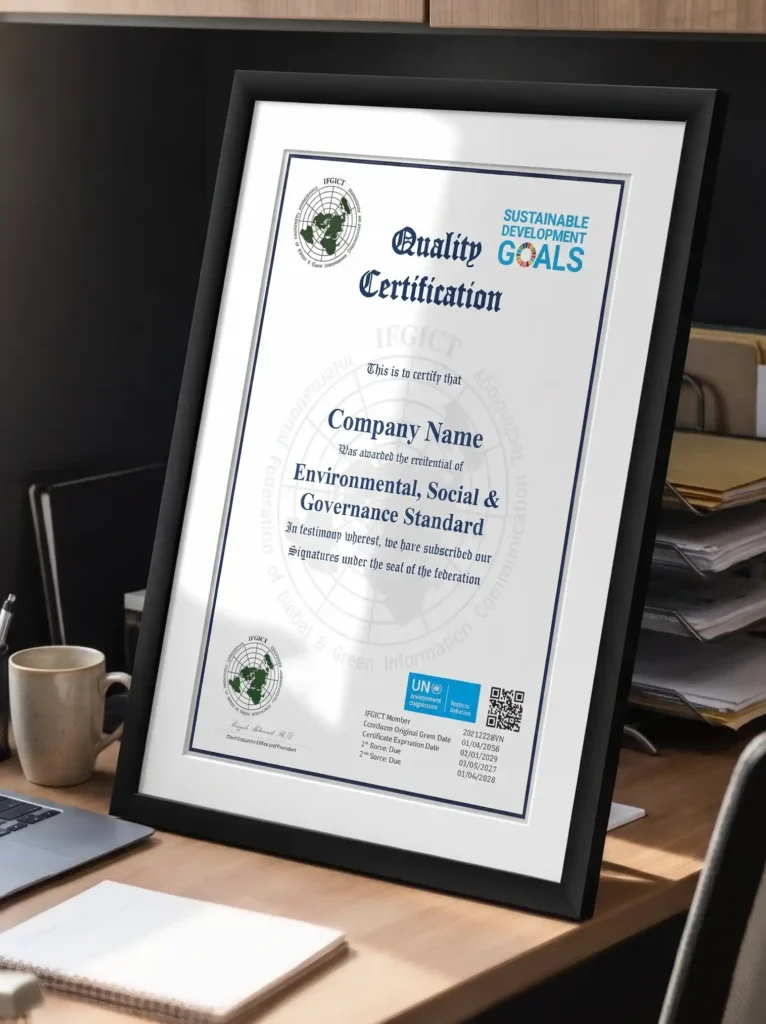
Understanding the ESG Standard Framework Certificate and Global Recognition
In an era saturated with unverified sustainability claims and “greenwashing,” stakeholders demand objective proof of corporate responsibility. The ESG Standard Framework Certificate serves as an independent, third-party validation that an enterprise’s operational policies, risk controls, and impact metrics meet strict international benchmarks—without burdening the organization with full-scale, multi-standard ISO implementation overhead.
The Authority Behind IFGICT: UN Listed, IEEE Partner, and ITU Affiliation
The credibility of any certification rests squarely on the institutional standing of its issuing body. The International Federation of Global & Green Information Communication Technology (IFGICT) is an established global non-profit federation headquartered in the United States and operating across five continents. Its regulatory and technical authority is reinforced by high-level international institutional recognition:
United Nations (UN) Listed Organization: IFGICT is officially approved and listed within United Nations partner registries—including the UN Department of Economic and Social Affairs (UN DESA) and the United Nations Environment Programme Finance Initiative (UNEP FI) Sustainable Blue Economy Finance Initiative—demonstrating direct alignment with global sustainable development mandates.
IEEE Partner: Through strategic collaboration with the Institute of Electrical and Electronics Engineers (IEEE), IFGICT integrates cutting-edge engineering standards, digital sustainability protocols, and technological ethics into its audit methodologies.
International Telecommunication Union (ITU) Engagement: As an active contributor and partner aligned with the ITU—the United Nations specialized agency for information and communication technologies—IFGICT ensures its framework addresses modern digital infrastructure, green ICT, data governance, and telecommunications sustainability.
This triad of international institutional standing guarantees that earning an ESG Standard Framework Certificate carries immediate weight with multinational procurement teams, institutional investors, financial lenders, and government regulators.
Why IFGICT’s Single Checklist Replaces Complex, Multi-Standard ISO Overheads
Traditionally, organizations attempting to formalize their sustainability posture faced an overwhelming challenge: hiring expensive consultants to implement ten different, overly complex ISO standards—each with hundreds of exhaustive clauses, separate external audits, and recurring multi-agency fees. For many agile enterprises, mid-sized companies, and growing institutions, applying the entirety of every individual ISO standard is neither practical nor cost-effective.
IFGICT solves this exact problem. IFGICT does not rely on forcing companies through complex, full-scale ISO certification audits; instead, following the IFGICT Checklist Framework Compliance is sufficient. IFGICT has curated the core, common operational pillars drawn from UN SDGs and ten foundational ISO frameworks and consolidated them into one practical checklist. Organizations gain:
One Unified Checklist Instead of Ten Complex Audits: Eliminates the need to apply entire ISO standards individually by consolidating their most impactful ESG controls into a single, easy-to-follow compliance framework.
Faster Time to Certification: Internal teams can quickly evaluate readiness, compile evidence against clear checklist criteria, and submit their compliance report without multi-year consulting delays.
Enhanced Capital Access & Investor Confidence: Satisfies the due diligence requirements of institutional investors, green bond issuers, and ESG-focused funds seeking verified governance and sustainability metrics.
Global Supply Chain Eligibility: Meets the Tier-1 vendor onboarding mandates of multinational corporations requiring audited ESG credentials from their suppliers.
Proactive Risk Mitigation: Identifies operational, environmental, cybersecurity, and compliance vulnerabilities early using practical, high-impact controls.
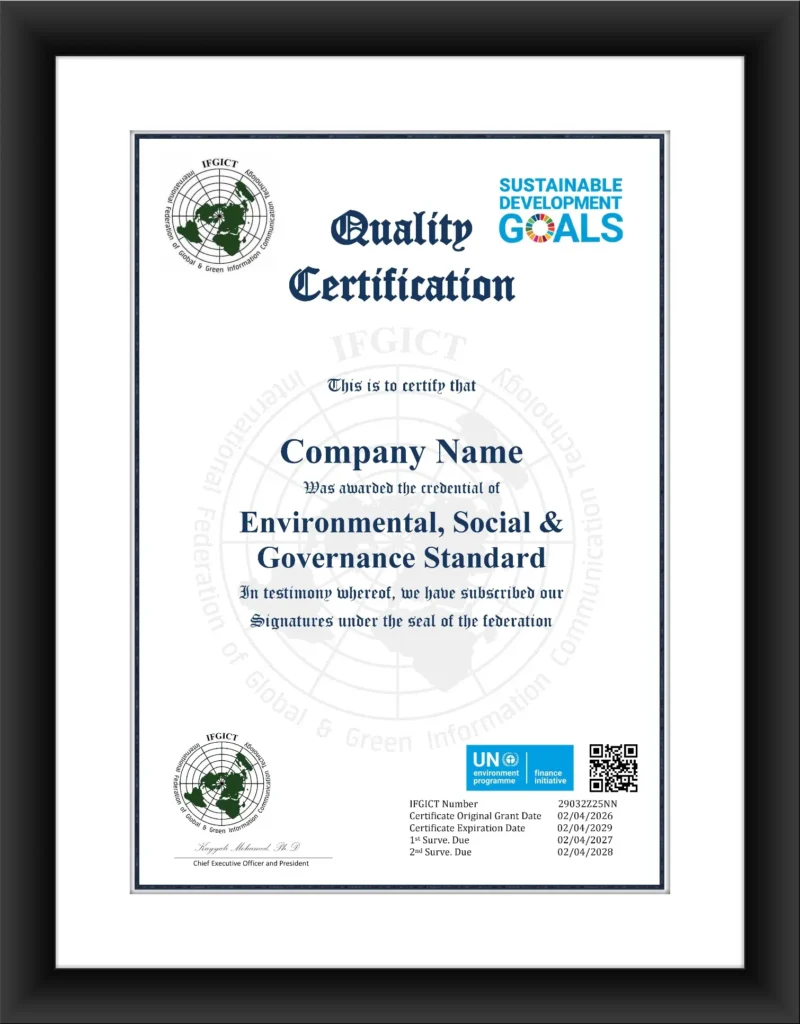
Strategic Alignment with the United Nations Sustainable Development Goals (UN SDGs)
A foundational pillar of the ESG Standard Framework Certificate is its structural alignment with the 17 United Nations Sustainable Development Goals (UN SDGs). Adopted by all UN Member States as the universal blueprint for peace and prosperity, the UN SDGs define the macro-level sustainability targets that modern enterprises must support.
Translating broad global goals—such as SDG 7 (Affordable and Clean Energy), SDG 8 (Decent Work and Economic Growth), SDG 12 (Responsible Consumption and Production), SDG 13 (Climate Action), and SDG 16 (Peace, Justice, and Strong Institutions)—into daily business operations can feel abstract without clear operational criteria.
IFGICT’s single checklist bridges this gap. When an organization completes the ESG Standard Framework Checklist Compliance by IFGICT, its internal practices and measurable outputs are mapped directly to relevant UN SDG targets. Rather than making vague pledges about climate action or social responsibility, certified organizations provide documented evidence of resource efficiency, workplace safety, inclusive governance, and ethical business conduct.
How Core ISO Standards Inform IFGICT’s Single ESG Checklist
Rather than requiring organizations to undergo full, exhaustive certification across ten separate ISO standards, IFGICT’s ESG framework gathers the most common, high-impact pillars from these ten ISO standards and integrates them alongside UN SDG principles into one unified compliance checklist. Following IFGICT’s checklist framework is completely sufficient to demonstrate structured ESG compliance.
Below is how the core principles of these ten ISO standards are distilled into the three pillars of IFGICT’s single ESG checklist:
Summary of Core ISO Pillars Integrated into the IFGICT ESG Checklist
| ESG Pillar | Reference ISO Standards Distilled into Checklist | Core Pillar Focus in IFGICT Checklist | Practical Compliance Outcome |
|---|---|---|---|
| Environmental (E) | ISO 14001, ISO 50001, ISO 14064 | Waste control, energy efficiency, basic GHG tracking | Lower environmental footprint, reduced energy costs, transparent emissions reporting |
| Social (S) | ISO 45001, ISO 30415, ISO 26000 | Workplace safety, inclusion, ethical social conduct | Safe working conditions, inclusive hiring & culture, responsible community & supply chain practices |
| Governance (G) | ISO 37001, ISO 37301, ISO 27001, ISO 9001 | Anti-bribery, compliance, data protection, process reliability | Zero-tolerance corruption controls, legal compliance, cyber resilience, consistent internal quality |
Environmental (E) Pillar: Practical Ecological Stewardship and Resource Efficiency
The Environmental section of IFGICT’s single checklist evaluates how an organization manages resources, minimizes waste, and tracks emissions—distilling the essential requirements of three international environmental standards without requiring full standalone ISO implementation:
Core Environmental Principles Drawn from ISO 14001 (Environmental Management)
ISO 14001 sets the international criteria for an Environmental Management System (EMS) to manage waste, lower footprints, and ensure legal compliance. Within the ESG Standard Framework Certificate checklist, IFGICT captures the practical essence of ISO 14001: verifying that an enterprise tracks its waste streams, prevents environmental pollution, complies with local environmental laws, and implements straightforward operational policies to reduce its ecological footprint.
Core Energy Principles Drawn from ISO 50001 (Energy Management)
ISO 50001 focuses on energy management systems to improve efficiency and reduce energy costs. Instead of complex industrial energy modeling, IFGICT’s checklist incorporates the core practical pillars of ISO 50001—helping organizations monitor utility consumption, identify obvious energy inefficiencies, adopt energy-saving practices, and steadily reduce operating energy expenses and carbon intensity.
Core Emissions Principles Drawn from ISO 14064 (Greenhouse Gas Accounting)
ISO 14064 guides the quantification and reporting of greenhouse gas (GHG) emissions. Within IFGICT’s unified checklist, organizations apply clear, standardized steps to measure and report their primary greenhouse gas emissions, establishing a transparent carbon baseline and demonstrating measurable progress toward decarbonization.
Social (S) Pillar: Protecting People, Safety, and Workplace Equity
The Social section of the ESG Standard Framework Certificate checklist ensures that an organization values human capital, maintains safe working conditions, and treats employees, customers, and communities fairly—gathering the essential pillars of three social ISO frameworks:
Core Safety Principles Drawn from ISO 45001 (Occupational Health and Safety)
ISO 45001 targets occupational health and safety to prevent workplace injuries and illnesses. IFGICT’s checklist distills the vital elements of ISO 45001 into clear, verifiable requirements: maintaining hazard-free workspaces, establishing emergency and incident reporting procedures, providing employee safety training, and demonstrating leadership commitment to physical and mental well-being.
Core Inclusion Principles Drawn from ISO 30415 (Diversity, Equity, and Inclusion)
ISO 30415 provides guidelines for diversity, equity, and inclusion (DEI) in the workplace. Under the ESG Standard Framework Certificate checklist, organizations demonstrate commitment to fair hiring practices, equal opportunity advancement, anti-discrimination policies, and an inclusive workplace culture without getting bogged down in overly complex human-resource bureaucracy.
Core Social Responsibility Principles Drawn from ISO 26000 (Social Responsibility)
ISO 26000 offers guidance on social responsibility across organizations. Because ISO 26000 is itself a guidance standard rather than a standalone certifiable standard, IFGICT’s checklist translates its core pillars—human rights respect, fair labor practices, ethical consumer engagement, and positive community contribution—into concrete, auditable checklist items.
Governance (G) Pillar: Enforcing Ethics, Security, and Reliable Internal Controls
The Governance section of the ESG Standard Framework Certificate checklist validates that leadership operates with integrity, protects sensitive data, and maintains dependable internal processes—synthesizing the core pillars of four governance ISO standards:
Core Anti-Corruption Principles Drawn from ISO 37001 (Anti-Bribery Management)
ISO 37001 establishes anti-bribery management systems to curb corruption. IFGICT’s checklist incorporates the essential safeguards of ISO 37001, verifying that organizations enforce clear anti-bribery policies, maintain transparent financial approvals, conduct basic due diligence on third-party partners, and provide safe channels to report unethical conduct.
Core Ethics Principles Drawn from ISO 37301 (Compliance Management)
ISO 37301 manages compliance and ethical business conduct. Within the ESG Standard Framework Certificate checklist, organizations demonstrate that they actively monitor applicable laws and industry regulations, maintain a clear code of ethics, and foster accountability across all management levels.
Core Cybersecurity Principles Drawn from ISO 27001 (Information Security)
ISO 27001 secures information and data management. Rather than requiring an exhaustive enterprise-wide ISO 27001 audit, IFGICT’s checklist captures the critical data-governance pillars: protecting customer and corporate data through access controls, secure backups, password and encryption hygiene, and basic cyber-incident response readiness.
Core Quality Principles Drawn from ISO 9001 (Quality Management)
ISO 9001 governs quality management and continuous process improvement, forming the structural foundation for reliable internal controls. IFGICT integrates the core governance logic of ISO 9001 into its checklist—ensuring organizations maintain clear standard operating procedures, documented accountability, internal review habits, and consistent service or product quality.
How Companies and Organizations Become Certified: The IFGICT Partnership and Checklist Compliance Pathway
IFGICT removes the traditional barriers, prohibitive consulting costs, and multi-standard complexity of sustainability certification through a direct, partnership-driven model.
Companies and organizations may request to become a partner with IFGICT to receive the ESG Standard Framework Checklist Compliance by IFGICT, enabling them to become certified upon submission of their report to IFGICT for audit certificate.
Because IFGICT consolidates the core UN SDG and ISO pillars into this single checklist, organizations do not need to pursue separate, complex ISO certifications. Following the ESG Standard Framework Checklist Compliance by IFGICT is completely sufficient to prepare, document, and earn certification.
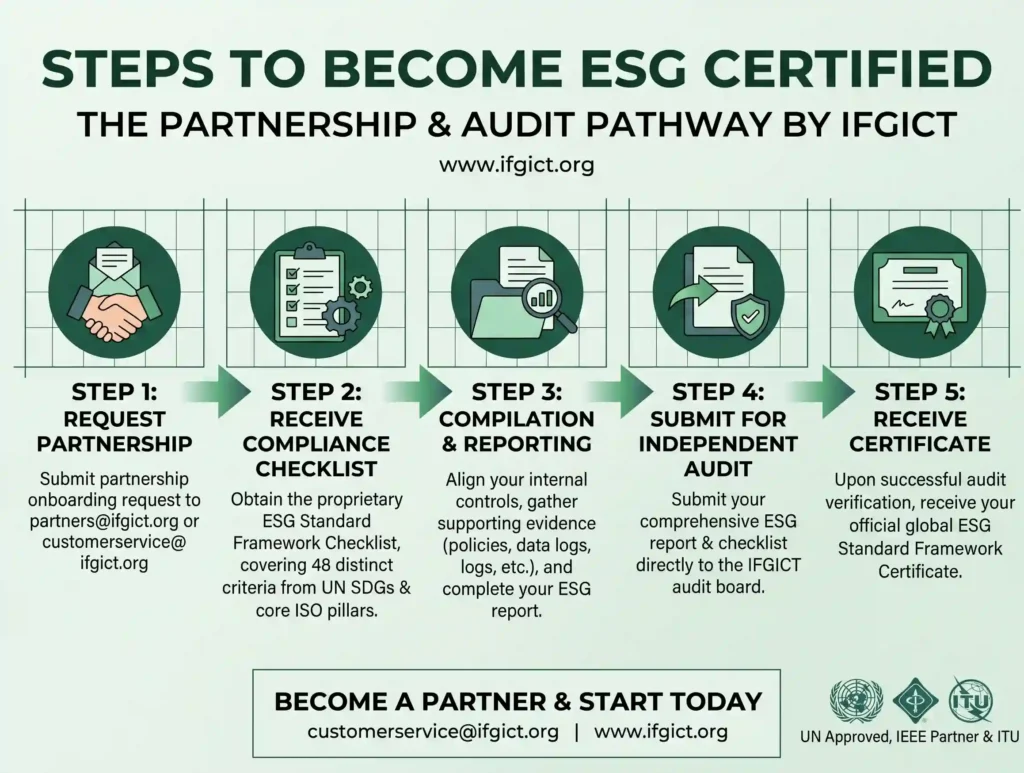
Step-by-Step Roadmap to Earning the ESG Standard Framework Certificate
Request Partnership with IFGICT: Organizations initiate the process by contacting IFGICT to request partnership onboarding. Becoming an IFGICT partner establishes official affiliation and grants access to IFGICT’s compliance framework resources.
Receive the Official ESG Standard Framework Checklist Compliance: Upon partnership approval, IFGICT delivers the proprietary ESG Standard Framework Checklist Compliance directly to the organization. This single, unified checklist brings together the most essential Environmental, Social, and Governance pillars drawn from UN SDGs and core ISO standards into one clear, easy-to-follow document.
Complete Internal Alignment Using the Single Checklist: Instead of navigating ten complex ISO manuals, your team simply follows the IFGICT checklist item by item—gathering supporting policies, operational records, and basic performance metrics into a single compliance report.
Submit Your Compliance Report to IFGICT for Audit: Once the checklist requirements are addressed and documented, the organization submits its completed ESG compliance report to IFGICT’s audit board for independent review.
Receive Your Official ESG Standard Framework Certificate: IFGICT auditors verify the submitted report against the checklist criteria. Upon successful audit clearance, IFGICT issues the official ESG Standard Framework Certificate, validating your organization’s global ESG compliance.
To request partnership and receive the official ESG Standard Framework Checklist Compliance, contact IFGICT today at [email protected]
Key Strategic Benefits of the ESG Standard Framework Certificate
Earning the ESG Standard Framework Certificate empowers organizations of every size to demonstrate credible sustainability leadership without unnecessary administrative burden:
Simplicity Without Sacrificing Credibility: Replaces the overwhelming burden of applying ten full ISO standards with a single, practical checklist backed by a UN-listed, IEEE-partnered, and ITU-affiliated organization.
Immediate B2B and Procurement Advantage: Satisfies corporate buyer and government tender requirements for verified ESG credentials, helping you win contracts faster.
Stronger Investor and Lender Appeal: Demonstrates structured risk management across environmental impact, workforce safety, anti-bribery, and cybersecurity—key factors for institutional investors and banks.
Lower Operational Costs: Practical energy, waste, and process controls drawn from ISO 50001, ISO 14001, and ISO 9001 directly reduce utility bills, material waste, and operational errors.
Higher Talent Retention and Brand Trust: Shows employees, customers, and partners that your organization upholds genuine standards for workplace safety, diversity, ethics, and data privacy.
Frequently Asked Questions (FAQ) About the ESG Standard Framework Certificate
1. What is the ESG Standard Framework Certificate by IFGICT?
The ESG Standard Framework Certificate is an internationally recognized sustainability credential issued by the International Federation of Global & Green Information Communication Technology (IFGICT). It validates an organization’s Environmental, Social, and Governance practices using a single, unified checklist built on core UN SDG and ISO principles.
2. Do we need to implement full ISO standards or hold separate ISO certificates to qualify?
No. IFGICT does not rely on complex, full-scale ISO standards; following the IFGICT Checklist Framework Compliance is completely sufficient. IFGICT gathers the most common, practical pillars from UN SDGs and ten core ISO standards into one streamlined checklist, saving organizations from the cost and complexity of implementing every ISO standard individually.
3. Is IFGICT recognized by international institutions?
Yes. IFGICT is officially approved and listed by the United Nations (including UN DESA and UNEP FI), operates as an official partner with the Institute of Electrical and Electronics Engineers (IEEE), and maintains active affiliation with the International Telecommunication Union (ITU). This ensures that your ESG Standard Framework Certificate carries global authority.
4. Which UN SDG and ISO pillars are combined into the IFGICT ESG checklist?
IFGICT’s single checklist integrates United Nations Sustainable Development Goals (UN SDGs) alongside the core practical pillars of ten foundational ISO standards:
Environmental (E): Core pillars from ISO 14001 (waste & environmental management), ISO 50001 (energy efficiency), and ISO 14064 (GHG emissions reporting).
Social (S): Core pillars from ISO 45001 (workplace health & safety), ISO 30415 (diversity, equity, and inclusion), and ISO 26000 (social responsibility).
Governance (G): Core pillars from ISO 37001 (anti-bribery), ISO 37301 (ethical compliance), ISO 27001 (information security), and ISO 9001 (quality & internal controls).
5. How does a company or organization get certified?
Companies and organizations may request to become a partner with IFGICT to receive the ESG Standard Framework Checklist Compliance by IFGICT. After completing the checklist requirements and compiling a compliance report, the organization submits its report to IFGICT for independent audit verification and issuance of the ESG Standard Framework Certificate.
6. Who is eligible to apply for the ESG Standard Framework Certificate?
Any business, startup, SME, multinational enterprise, university, healthcare institution, or non-profit organization seeking a practical, credible, and globally recognized ESG credential can apply to partner with IFGICT.
7. How can we request partnership and get the IFGICT ESG checklist?
Simply reach out to the IFGICT team via email at [email protected] to request partnership onboarding and receive your ESG Standard Framework Checklist Compliance.
Checkout ISO Certification Body