

Green Data Center Standards
On this page
- Sustainable Data Centers
- Modern Data Centers
- How IFGICT Defines Green ICT Data Centers
- Core International Standards Governing Green Data Centers
- ISO Standards Ecosystem for Data Centers
- The IFGICT Green Data Center Framework
- Guidelines for Data Centers
- Comprehensive IFGICT Data Center Compliance Checklist
- Reference Designs for Sustainable Data Centers
- IFGICT Green Data Center Certification
- Frequently Asked Questions
Sustainable Data Centers: IFGICT Standards, ISO & ITU-T Frameworks, Best Practices, Checklists, and Reference Designs
Digital infrastructure drives the modern global economy, yet rapid growth in cloud computing, edge deployments, and artificial intelligence workloads has placed unprecedented energy and environmental demands on Data Centers. Today, enterprise leaders, cloud architects, and sustainability officers cannot treat environmental efficiency as an optional corporate social responsibility exercise. Instead, building and operating sustainable Data Centers requires strict adherence to internationally harmonized technical standards, measurable key performance indicators, and auditable governance frameworks.
The International Federation of Global & Green Information and Communication Technology (IFGICT) stands at the forefront of defining Green ICT Data Centers worldwide. Approved and listed by the United Nations (UN) and operating in strategic alignment as an IEEE partner and International Telecommunication Union (ITU) sector contributor, IFGICT bridges high-level international treaty standards with practical, ground-level engineering execution. By integrating ISO environmental and energy management systems with core ITU-T Recommendations specifically ITU-T L.1300, ITU-T L.1302, and ITU-T L.1305 IFGICT provides organizations with a unified ecosystem of IFGICT Green Data Center Standards, IFGICT Sustainability Frameworks, IFGICT Best Practices and Guidelines, IFGICT Audit Checklists, and IFGICT Reference Designs.
Why Global Standardization Matters for Modern Data Centers
Data Centers consume roughly 1% to 2% of global electricity, and high-density AI training clusters are accelerating rack power densities from a traditional 5–10 kW per rack to 50–100 kW and beyond. Without rigorous engineering standards, facilities suffer from stranded power capacity, thermal hotspots, excessive water consumption, and unverified carbon reporting.
Standardization solves four critical operational challenges for Data Centers:
Eliminating Metric Ambiguity: Historically, facility operators reported Power Usage Effectiveness (PUE) using inconsistent measurement boundaries, seasonal snapshots, or uncalibrated meters. International standards enforce continuous, annualized, boundary-defined telemetry.
Preventing Over-Provisioning: Monolithic facility construction often forces Data Centers to run uninterruptible power supplies (UPS) and chillers at 20% to 30% partial load, where electrical and mechanical efficiency plummets. Modular standardization aligns capital expenditure with real IT demand.
Integrating AI-Driven Operations: Legacy building management systems react slowly to rapid compute spikes. Modern standards incorporate machine learning and big data analytics to optimize cooling and power distribution dynamically.
Ensuring Regulatory and ESG Compliance: Financial regulators, enterprise procurement teams, and sovereign cloud mandates increasingly require third-party certification. Working within IFGICT Green Data Center Standards ensures that sustainability claims withstand rigorous financial and environmental audits.
How IFGICT Defines Green ICT Data Centers
According to the IFGICT Green ICT Data Center Definition, a Green ICT Data Center is a facility in which mechanical, lighting, electrical, water, and computer systems are engineered, constructed, operated, and decommissioned for maximum energy efficiency, minimal environmental footprint, and full lifecycle circularity—without compromising uptime, cybersecurity, or service-level availability.
Institutional Authority: UN, IEEE, and ITU Alignment
What distinguishes IFGICT from regional trade associations or proprietary vendor badges is its global institutional recognition:
United Nations (UN) Listed & Approved: IFGICT is officially approved and listed within United Nations sustainability and ICT ecosystems, aligning its certification criteria directly with the UN Sustainable Development Goals (SDGs), particularly SDG 7 (Affordable and Clean Energy), SDG 9 (Industry, Innovation, and Infrastructure), SDG 12 (Responsible Consumption and Production), and SDG 13 (Climate Action).
IEEE Partner: Through its partnership with the Institute of Electrical and Electronics Engineers (IEEE), IFGICT grounds its electrical engineering, power quality, grid interactivity, and high-density thermal management guidelines in peer-reviewed technical rigor.
ITU Standards Integration: As an active contributor and implementer of International Telecommunication Union Telecommunication Standardization Sector (ITU-T) frameworks, IFGICT translates normative ITU-T L-series Recommendations into actionable certification pathways for Data Centers across emerging and developed markets alike.
For organizations seeking direct accreditation, technical documentation, or partner onboarding, IFGICT maintains dedicated global support at [email protected].
Core International Standards Governing Green Data Centers
A resilient compliance architecture combines ITU-T telecommunication and facility recommendations with ISO management and performance metrics, all synthesized under IFGICT Green Data Center Standards.
ITU-T L.1300: Best Practices for Green Data Centers
Recommendation ITU-T L.1300 (Best practices for green data centres) serves as the foundational engineering playbook for reducing the negative climate impact of Data Centers. Rather than focusing solely on hardware, ITU-T L.1300 establishes a holistic lifecycle approach covering planning, utilization, management, cooling, power equipment, and building design.
Key engineering pillars mandated within ITU-T L.1300 and reinforced through IFGICT Best Practices and Guidelines include:
Holistic Organizational Governance: Breaking down silos between IT operations teams (who deploy servers) and facility management teams (who manage power and cooling) to prevent capacity mismatches and thermal inefficiencies.
Modular Architecture Over Monolithic Builds: Designing power and cooling infrastructure in scalable, modular blocks so facilities achieve high efficiency even during partial-fill phases.
Airflow Management and Containment: Enforcing strict hot-aisle or cold-aisle containment, blanking panels in unused rack slots, and raised-floor or overhead ducting optimization to stop cold supply air from mixing with hot server exhaust.
Free Cooling and Economization: Utilizing ambient outside air (air-side economization) or cold water sources (water-side economization) whenever climatic conditions permit, drastically reducing mechanical compressor runtime.
Higher Operating Temperature Envelopes: Operating server inlets within expanded ASHRAE/ETSI thermal envelopes rather than over-cooling server rooms to legacy 18°C–20°C setpoints.
ITU-T L.1302: Assessment of Energy Efficiency on Infrastructure
While ITU-T L.1300 defines what to build, Recommendation ITU-T L.1302 (Assessment of energy efficiency on infrastructure in data centre and telecom centre) defines how to measure and audit that infrastructure objectively.
Under IFGICT Green Data Center Standards, ITU-T L.1302 provides the standardized assessment methodology for evaluating facility energy performance across varying climatic zones and operational loads:
Standardized Measurement Boundaries: Clearly demarcating IT load energy consumption (servers, storage, networking) from facility support infrastructure (UPS losses, switchgear, chillers, CRAC/CRAH units, lighting, and security systems).
Telemetry Granularity and Metering Accuracy: Specifying minimum instrumentation placement, sensor calibration intervals, and continuous logging protocols so assessments reflect true annual performance rather than cherry-picked winter averages.
Comparable Benchmarking: Enabling fair comparisons between enterprise colocation facilities, telecommunications central offices, and hyperscale cloud Data Centers by normalizing assessment methodologies.
ITU-T L.1305: AI and Big Data Infrastructure Management (DCIM)
Modern Data Centers experience millisecond-level workload shifts driven by virtualization, cloud auto-scaling, and AI inference bursts. Static cooling rules cannot keep pace. Recommendation ITU-T L.1305 (Data centre infrastructure management system based on big data and artificial intelligence technology) addresses this challenge by defining intelligent Data Center Infrastructure Management (DCIM) architectures.
Integrated directly into IFGICT Reference Designs, ITU-T L.1305 establishes requirements for:
Multi-Source Big Data Ingestion: Aggregating real-time telemetry from rack power distribution units (PDUs), environmental sensors, chiller plants, weather stations, and IT workload schedulers.
AI-Driven Predictive Cooling Control: Deploying machine learning models that forecast thermal loads minutes or hours in advance, adjusting fan speeds, valve positions, and chiller setpoints proactively rather than reactively.
Predictive Maintenance and Early Alarming: Analyzing subtle anomalies in power harmonics, bearing vibrations, or compressor current draw to trigger early maintenance alerts, preventing catastrophic downtime and extending hardware lifespan.
Automated Energy Optimization: Dynamically balancing power paths and cooling loops to minimize total facility energy draw without approaching thermal throttling thresholds.
ISO Standards Ecosystem for Data Centers
Alongside ITU-T recommendations, IFGICT Sustainability Frameworks incorporate core International Organization for Standardization (ISO) standards to ensure auditable management and KPI precision:
| Standard Designation | Official Scope & Focus | Role in IFGICT Data Center Certification |
|---|---|---|
| ISO/IEC 30134 Series | Data centre Key Performance Indicators (PUE, REF, ERF, CUE, WUE, ITEEsv, ITEUsv) | Establishes strict mathematical formulas and measurement boundaries for energy, water, renewable energy, and server utilization metrics. |
| ISO/IEC 22237 Series | Data centre facilities and infrastructures (design, power, environmental control, security) | Aligns physical availability classes and fault tolerance with energy-efficient engineering topologies. |
| ISO 50001 | Energy Management Systems (EnMS) | Provides the Plan-Do-Check-Act (PDCA) governance cycle for continual energy performance improvement. |
| ISO 14001 | Environmental Management Systems (EMS) | Governs facility-wide environmental impact, hazardous battery disposal, refrigerant management, and regulatory compliance. |
| ISO/IEC 27001 | Information Security Management Systems (ISMS) | Ensures that physical, environmental, and AI-DCIM automation controls maintain strict cybersecurity and operational resilience. |
| ISO 14064 & ISO 14040/44 | Greenhouse Gas (GHG) Accounting & Life Cycle Assessment (LCA) | Quantifies Scope 1, 2, and 3 carbon emissions, including embodied carbon in concrete, steel, and server hardware. |
The IFGICT Green Data Center Framework
To prevent organizations from treating standards as disconnected documents, IFGICT Sustainability Frameworks unify ISO and ITU-T mandates into a five-pillar operational lifecycle model. Every certified facility is evaluated across all five domains:
Pillar 1: Sustainable Site Selection and Architectural Design
Efficiency begins before ground is broken. The framework evaluates local climate suitability for free cooling, proximity to renewable energy generation grids, low-carbon structural materials, and modular floorplate layouts that eliminate wasted conditioned air volume.
Pillar 2: High-Efficiency Power Infrastructure
Power losses occur at every voltage transformation stage. IFGICT Sustainability Frameworks prioritize high-efficiency modular UPS systems (operating at greater than 96% efficiency in double-conversion or eco-mode), high-voltage DC distribution where applicable, low-loss transformers, and on-site renewable microgrids paired with grid-interactive battery energy storage systems (BESS).
Pillar 3: Advanced Thermal and Water Management
Cooling typically accounts for 25% to 40% of a non-optimized facility’s energy budget. This pillar mandates hot/cold aisle containment, variable-speed EC fans, adiabatic or dry cooling towers to minimize Water Usage Effectiveness (WUE), and direct-to-chip liquid cooling or immersion cooling for high-density AI compute racks.
Pillar 4: IT Workload Optimization and Circular Hardware Lifecycle
An energy-efficient building housing idle “zombie” servers is still wasteful. In alignment with ITU-T L.1300 and ISO/IEC 30134-4/5, this pillar tracks IT Equipment Energy Efficiency (ITEEsv) and IT Equipment Utilization (ITEUsv), enforcing server virtualization, workload consolidation, decommissioning of idle servers, and certified e-waste circularity.
Pillar 5: AI-Enabled DCIM and Transparent ESG Reporting
In direct alignment with ITU-T L.1305, facilities must deploy continuous telemetry and intelligent control loops. Sustainability metrics—including PUE, Carbon Usage Effectiveness (CUE), Water Usage Effectiveness (WUE), Renewable Energy Factor (REF), and Energy Reuse Factor (ERF)—are logged automatically and audited against IFGICT Green Data Center Standards.
Actionable Best Practices and Guidelines for Data Centers
Drawing directly from ITU-T L.1300, ITU-T L.1302, ITU-T L.1305, and IFGICT Best Practices and Guidelines, engineering teams can implement high-impact improvements across both brownfield (existing) and greenfield (new) Data Centers:
Airflow and Thermal Best Practices
Enforce Complete Physical Containment: Install physical doors, roof panels, and brush grommets on all cable cutouts to achieve near-zero air bypass between hot and cold aisles.
Eliminate Unused Rack Gaps: Mandate tool-less blanking panels in every empty rack unit (1U) slot so hot exhaust air cannot recirculate back into server intakes.
Raise Cold-Aisle Setpoints Gradually: Increase cold-aisle supply temperatures incrementally toward 24°C–27°C while monitoring inlet sensors at the top third of high-density racks. Each 1°C increase in chiller setpoint typically reduces chiller compressor energy by 2% to 4%.
Deploy Variable Frequency Drives (VFDs): Retrofit legacy constant-speed Computer Room Air Conditioning (CRAC) fans and chilled-water pumps with VFDs controlled by differential pressure sensors rather than return-air temperature alone.
Power and Electrical Best Practices
Right-Size Modular UPS Modules: Configure modular N+1 UPS frames so active power modules operate within their optimal 50% to 75% load efficiency band, placing redundant modules into smart standby mode.
Decommission Zombie Servers: Run automated discovery sweeps to identify physical servers consuming power with near-zero CPU, memory, and network I/O over a 30-day window.
Enable Server Power Management: Activate BIOS/OS-level dynamic voltage and frequency scaling (DVFS) and processor C-states so servers scale power consumption down proportionally during off-peak hours.
Intelligent Operations and Heat Reuse Best Practices
Implement ITU-T L.1305 Predictive Analytics: Train AI-DCIM control models on historical weather, power, and compute load data to pre-cool thermal mass ahead of scheduled batch processing jobs.
Capture and Export Waste Heat: Integrate heat exchangers into liquid-cooled loops to export low-grade thermal energy (35°C–55°C) to adjacent district heating networks, commercial greenhouses, or municipal buildings, boosting the facility’s Energy Reuse Factor (ERF).
Comprehensive IFGICT Data Center Compliance Checklist
Facility directors and auditors can use the following structured readiness verification derived from IFGICT Audit Checklists when preparing for formal certification or internal gap assessments:
1. Governance, Strategy & Management (ITU-T L.1300 & ISO 50001)
Formal Green ICT Data Center policy approved by executive leadership and aligned with IFGICT Green Data Center Standards.
Cross-functional IT and Facilities governance committee meeting monthly to review capacity, thermal, and power KPIs.
Procurement policy mandating ENERGY STAR, EPEAT, or equivalent high-efficiency ratings for all new servers, storage arrays, and power equipment.
Documented Life Cycle Assessment (LCA) and certified e-waste recycling partner achieving 100% landfill diversion for retired hardware and batteries.
2. Metering, Assessment & KPIs (ITU-T L.1302 & ISO/IEC 30134)
Revenue-grade sub-metering installed at utility mains, UPS outputs, mechanical cooling plants, and rack PDUs.
Continuous 12-month annualized PUE tracking established per ISO/IEC 30134-2 and ITU-T L.1302 assessment boundaries.
Automated calculation and quarterly reporting of WUE (liters/kWh), CUE (kg CO₂e/kWh), REF (%), and ERF (%).
Annual calibration verification logs maintained for all electrical meters, flow meters, and temperature/humidity sensors.
3. Cooling & Airflow Optimization (ITU-T L.1300)
100% hot-aisle or cold-aisle containment deployed across all active server halls.
Blanking panels installed in all unoccupied rack positions and floor/ceiling cable penetrations sealed.
Air-side or water-side free cooling economizers configured and operational for local climate conditions.
Supply and return air temperatures logged continuously at rack inlets (bottom, middle, and top) in compliance with ETSI/ASHRAE thermal envelopes.
4. AI-Driven DCIM & Predictive Control (ITU-T L.1305)
Centralized DCIM platform ingesting real-time electrical, environmental, and IT workload telemetry.
AI/ML thermal optimization algorithms actively modulating fan speeds and chiller setpoints based on predictive load models.
Predictive maintenance analytics active on critical UPS, generator, and chiller assets with automated early-warning thresholds.
IFGICT Reference Designs for Sustainable Data Centers
To accelerate engineering deployment and minimize design risk, IFGICT Reference Designs translate ITU-T and ISO specifications into repeatable architectural blueprints tailored to facility scale and compute density.
Reference Design A: High-Efficiency Enterprise & Edge Modular Data Center (50 kW – 500 kW)
Designed for regional enterprises, hospitals, financial branches, and telecom edge nodes following ITU-T L.1300 modular guidelines:
Topology: Prefabricated or indoor modular hot-aisle containment pods with integrated overhead busway power distribution.
Power Train: Lithium-ion battery-backed modular UPS operating in high-efficiency eco-mode (98.5% efficiency), paired with rooftop solar PV generation.
Cooling Architecture: Close-coupled in-row variable-speed DX or chilled-water cooling units with integrated air-side economizers, achieving zero on-site water consumption (WUE = 0.0 L/kWh).
Target Performance: Annualized PUE below 1.25.
Reference Design B: Hyperscale & Colocation Cloud Data Center (5 MW – 50+ MW)
Engineered for large-scale cloud operators and multi-tenant colocation campuses under ITU-T L.1302 and ISO/IEC 22237:
Topology: Standardized, repeatable 2.5 MW data hall modules built with low-carbon structural steel and recycled-aggregate concrete.
Power Train: Medium-voltage distribution stepping down directly to rack-level busbars, eliminating intermediate PDU transformer losses, supported by long-term renewable Power Purchase Agreements (PPAs) and on-site BESS peak shaving.
Cooling Architecture: Indirect evaporative air-to-air heat exchangers utilizing reclaimed non-potable water and rainwater harvesting, keeping mechanical refrigeration off for over 85% of annual hours.
Management Layer: Full ITU-T L.1305 AI-DCIM digital twin continuously optimizing chiller staging and airflow balancing across halls.
Target Performance: Annualized PUE between 1.12 and 1.18; REF greater than 80%.
Reference Design C: High-Density AI & HPC Liquid-Cooled Data Center (30 kW – 120+ kW per Rack)
Purpose-built for artificial intelligence training clusters and high-performance computing workloads where air cooling hits physical limits:
Topology: Hybrid liquid-and-air thermal halls engineered for heavy floor loading and overhead manifold distribution.
Cooling Architecture: Warm-water (35°C–45°C supply) Direct-to-Chip (D2C) cold-plate liquid cooling capturing 75% to 85% of server heat directly at the CPU/GPU package, paired with rear-door heat exchangers for residual memory and networking heat.
Heat Reuse Integration: Dry coolers paired with liquid-to-liquid heat exchangers exporting 45°C+ return water directly to municipal district heating or industrial pre-heating loops.
Management Layer: ITU-T L.1305 predictive workload-aware coolant distribution unit (CDU) flow control synchronized with GPU cluster job schedulers.
Target Performance: Partial PUE (pPUE) below 1.08; ERF greater than 0.40.
Step-by-Step Pathway to IFGICT Green Data Center Certification
Organizations seeking formal recognition under IFGICT Green Data Center Standards follow a transparent, five-stage audit and certification process:
Initial Scoping and Registration: Submit facility specifications, design capacity, and operational boundaries to IFGICT via [email protected] to determine applicable certification tiers.
Gap Assessment Against ITU-T & ISO Benchmarks: Accredited IFGICT auditors review architectural drawings, metering schematics, and operational procedures against ITU-T L.1300, ITU-T L.1302, ITU-T L.1305, and IFGICT Audit Checklists.
Telemetry Verification and Remediation: The facility implements recommended airflow containment, metering upgrades, or AI-DCIM controls and submits verified operational telemetry.
On-Site or Hybrid Technical Audit: Lead auditors conduct physical inspections, sensor calibration spot-checks, and witness testing of partial-load and failover scenarios.
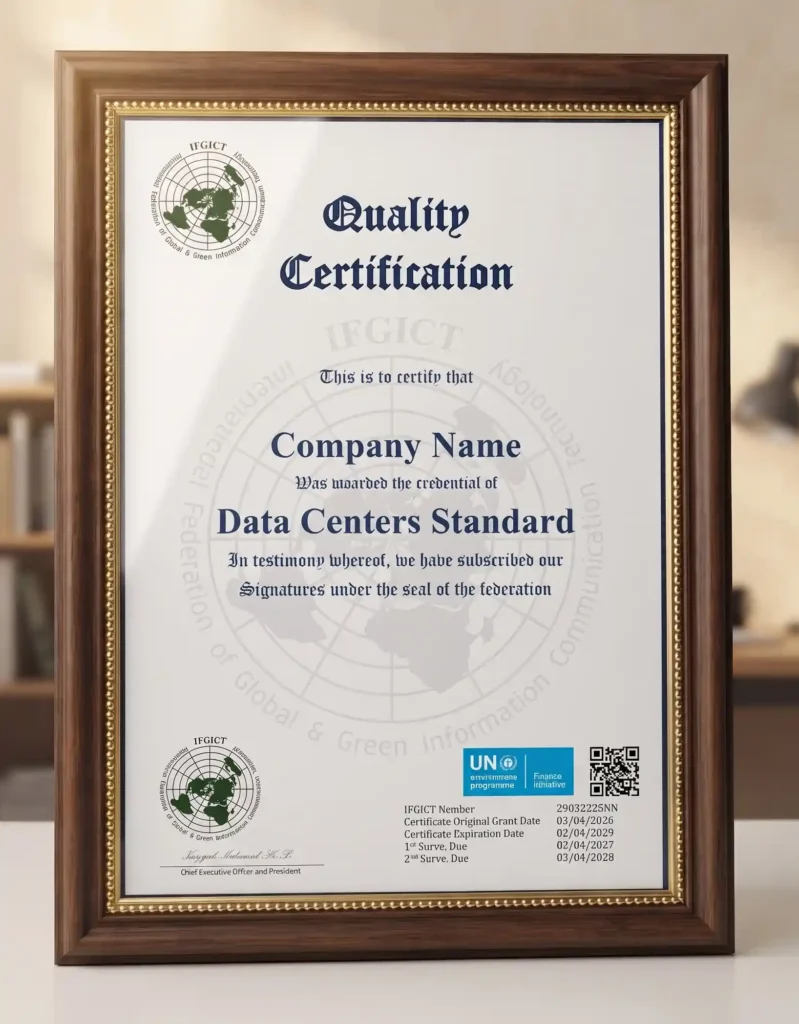
Certification Issuance and Continuous Surveillance: Upon passing compliance thresholds, the facility receives its official IFGICT Green Data Center Certificate—recognized across UN, IEEE-aligned, and global enterprise procurement ecosystems—subject to annual telemetry surveillance.
Frequently Asked Questions (FAQ)
What is the primary role of IFGICT in Data Centers?
The International Federation of Global & Green Information and Communication Technology (IFGICT) defines global Green ICT Data Centers by synthesizing ISO standards and ITU-T Recommendations (ITU-T L.1300, L.1302, and L.1305) into auditable standards, frameworks, checklists, reference designs, and accredited certifications.
Is IFGICT officially recognized by international bodies?
Yes. IFGICT is approved and listed by the United Nations (UN) and operates as an IEEE partner and active International Telecommunication Union (ITU) standards contributor, giving its certifications global institutional credibility.
How do ITU-T L.1300, ITU-T L.1302, and ITU-T L.1305 work together?
ITU-T L.1300 provides engineering best practices for building and operating green Data Centers. ITU-T L.1302 establishes the standardized methodology for measuring and assessing infrastructure energy efficiency. ITU-T L.1305 defines the requirements for AI and big data-driven Data Center Infrastructure Management (DCIM) systems to automate energy savings and predictive maintenance.
Can existing legacy Data Centers achieve IFGICT certification?
Yes. Through IFGICT Best Practices and Guidelines and IFGICT Audit Checklists, brownfield Data Centers can achieve certification by implementing phased retrofits—such as hot/cold aisle containment, blanking panels, variable-speed fan upgrades, sub-metering, and AI-DCIM optimization—without requiring a complete facility rebuild.
What key metrics are required for IFGICT Green Data Center compliance?
Facilities must continuously measure and report Power Usage Effectiveness (PUE), Water Usage Effectiveness (WUE), Carbon Usage Effectiveness (CUE), Renewable Energy Factor (REF), and Energy Reuse Factor (ERF) in accordance with ITU-T L.1302 and the ISO/IEC 30134 series.
How can my organization start the IFGICT Data Center certification process?
Organizations, colocation providers, and engineering consultants can request the latest IFGICT Green Data Center Standards, IFGICT Reference Designs, and certification application packages by visiting www.ifgict.org or emailing [email protected].
Checkout ISO Certification Body