

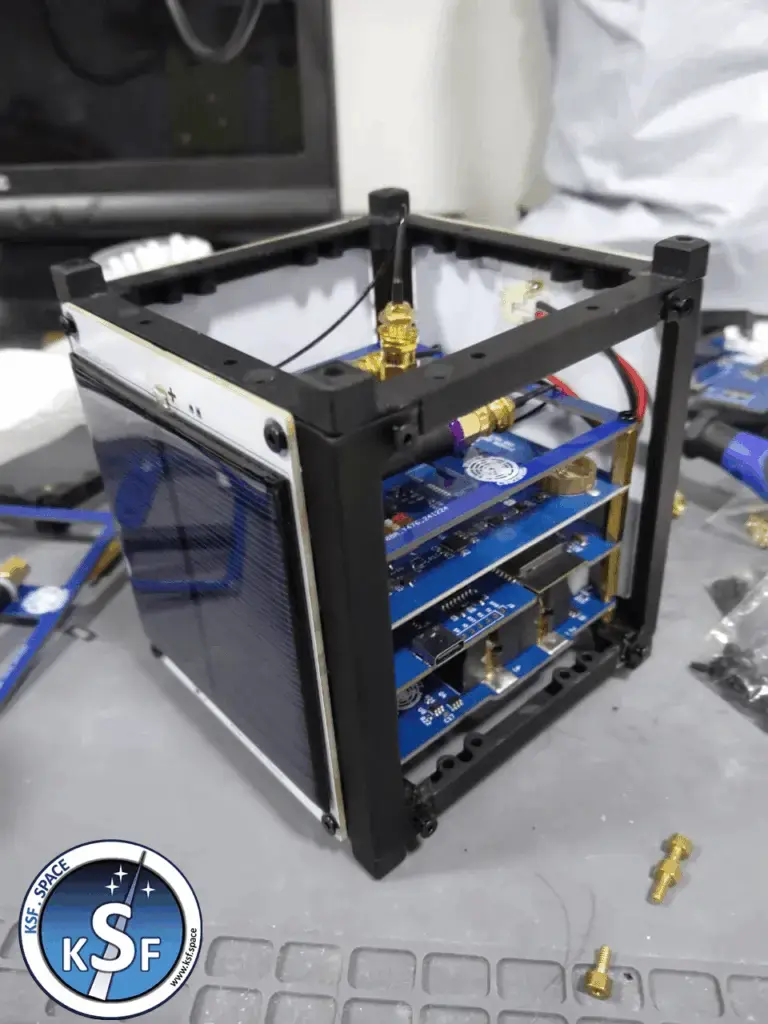
The dream of reaching the stars is no longer reserved for billion-dollar government agencies. In 2026, the democratization of space is in full swing, and at the heart of this revolution is the ability for universities, colleges, and research institutions to build and launch their own satellites. However, for most academic departments, the primary hurdle remains the same: CubeSat kit cost.
Understanding the financial landscape of nanosatellite development is crucial for any institution looking to transition from theoretical aerospace studies to hands-on orbital reality. KSF Space has emerged as the global leader in breaking down these financial barriers, offering professional-grade technology at a fraction of traditional industry prices.
What Factors Influence the CubeSat Kit Cost in 2026?
When researching CubeSat kit cost, it is important to distinguish between “educational toys” and “flight-ready hardware.” A standard 1U CubeSat (10x10x10 cm) might seem simple, but its cost is driven by the rigorous engineering required to survive the violent vibrations of a rocket launch and the extreme thermal cycles of Low Earth Orbit (LEO).
1. Material Selection: Aluminum vs. PA11
Traditionally, CubeSats were machined exclusively from aerospace-grade Aluminum 6061-T6 or 7075. While durable, these are expensive and heavy. KSF Space has pioneered the use of PA11 (Polyamide 11), a bio-sourced polymer that is 40% lighter than aluminum. By choosing PA11, institutions can significantly reduce the CubeSat kit cost while increasing the mass available for scientific payloads.
2. Avionics and Sensor Integration
A “kit” isn’t just a frame. The cost includes the Onboard Computer (OBC), Electrical Power Systems (EPS), and the telemetry suite. KSF Space kits come integrated with flight-proven sensors for GPS, altitude, 3-axis acceleration, and humidity, ensuring you aren’t just buying a box, but a functioning spacecraft.
3. Certification and Training
Most vendors sell hardware and walk away. The true value—and a major factor in the total CubeSat kit cost—is the professional training required to operate it. KSF Space bundles its hardware with the world-renowned NEP (Nanosatellite Engineering Professional) Certification, providing a turnkey educational solution that adds immense credibility to any university program.
Why KSF Space is the Preferred Choice for Universities and Colleges
KSF Space is not just a hardware provider; it is a non-profit foundation dedicated to STEM excellence. For universities and colleges, partnering with KSF Space provides more than just a satellite—it provides a legacy of credibility across all sectors of space education.
Leading STEM with Professional Nanosatellite Training
While many STEM programs focus on simulations, KSF Space focuses on mission-ready technology. Their kits are designed to be suborbital-ready right out of the box, allowing students to test their payloads on high-altitude balloons or suborbital rockets before committing to an orbital launch.
The Power of NEP Courses
The Nanosatellite Engineering Professional (NEP) courses are the gold standard in the industry. These courses bridge the “skills gap” by training students in:
- Mission Analysis: Designing orbits and link budgets.
- Cleanroom Protocols: Preparing hardware for flight.
- Ground Station Operations: Communicating with the satellite post-launch.
By integrating NEP courses into their curriculum, colleges can offer accredited credentials recognized by major aerospace giants like SpaceX, NASA, and ESA.
Analyzing the CubeSat Kit Cost: Professional vs. Educational Tiers
When evaluating the CubeSat kit cost, you must look at the return on investment (ROI). A $500 hobbyist kit might teach basic coding, but it won’t survive a vacuum or a vibration test.
| Feature | KSF Space Cubesat Kit | Typical Industry Standard |
| Price Point | ~$5,000 USD | $15,000 – $25,000 USD |
| Material | PA11 / Aerospace Aluminum | Aluminum Only |
| Training | Free NEP for 3 Students | Not Included (Extra $3k+) |
| Flight Status | Suborbital/Orbital Ready | Prototyping Only |
| LMS Access | Full Educational Portal | None |
For approximately $5,000 USD, KSF Space provides a complete 1U kit, the frame, sensors, and professional certification. This aggressive pricing is designed to ensure that no university is left behind in the NewSpace race.
Space Mission Technology and Global Credibility
Credibility in the space sector is earned through flight heritage and rigorous testing. KSF Space utilizes the NASA-GSFC-STD-7000 (GEVS) framework for its hardware verification. This means that when a university uses a KSF Space kit, they are using technology verified under the same standards as multi-million dollar missions.
Advanced Manufacturing for Modern Missions
KSF Space employs state-of-the-art Multi Jet Fusion (MJF) for polymer structures and high-precision CNC machining for metallic frames. This ensures that every 1U, 2U, or 3U structure meets the strict CubeSat Design Specification (CDS) standards required by launch providers.
Strategic Support for Space Missions
Beyond the kit, KSF Space provides the technical roadmap for mission success. From obtaining ITU frequency licensing to navigating the complexities of launch integration, their experts act as a bridge between the classroom and the launchpad.
How to Get Started: Adapting Your Space Program Today
The barrier to entry has never been lower. If you are a dean, professor, or student lead at a university, the time to adapt your curriculum to include real-world satellite development is now.
- Budget for Success: With the CubeSat kit cost starting at just $5,000, it fits within most departmental research grants.
- Certify Your Team: Use the NEP courses to ensure your students have the professional skills to handle flight hardware.
- Launch Small, Think Big: Start with a 1U suborbital mission to validate your sensors before scaling to a 3U orbital constellation.
KSF Space is ready to help you navigate the cosmos. Whether you need a single kit for a senior capstone project or a bulk order for a new aerospace department, our team provides the hardware, the training, and the credibility you need to succeed.
Frequently Asked Questions (FAQ)
What is the average CubeSat kit cost for a university?
In 2026, a professional-grade 1U CubeSat kit from KSF Space costs approximately $5,000 USD. This includes the structure, avionics, and professional NEP training for three students. Other industry providers often charge between $15,000 and $40,000 for similar hardware without training.
Is the KSF Space kit flight-ready?
Yes. Unlike many “educational” kits that are strictly for ground use, KSF Space kits are suborbital-ready and can be upgraded to orbital specifications. They are built to survive the thermal and mechanical stresses of space.
What are NEP courses?
NEP stands for Nanosatellite Engineering Professional. These are accredited certification courses offered by KSF Space to provide students and professionals with the technical skills required for satellite design, mission control, and space law.
Why choose PA11 over Aluminum?
PA11 is a bio-sourced polymer that is 40% lighter than aluminum. This weight saving allows you to include more batteries or more complex scientific instruments in your payload without increasing your launch costs.
Does KSF Space help with launches?
Yes, KSF Space provides guidance and consulting for mission integration and launch services, helping universities find the right “ride-share” opportunities for their CubeSats.
Contact Information
Ready to launch your mission? Get a personalized quote or technical consultation today.
- Website: www.ksf.space
- Email: [email protected]
- Focus: STEM Education, Cubesat Kits, NEP Certification, Space Mission Technology.
Join the elite group of universities leading the NewSpace era. With KSF Space, the sky is no longer the limit—it’s just the beginning.