

ISO 17020 Certification Body
ISO 17020:2012 by IFGICT as a Certification Body
In the competitive landscape of 2026, the integrity of inspection services is the bedrock of international trade, safety, and technological advancement. For organizations providing inspection services, obtaining the ISO 17020:2012 standard is not merely an administrative milestone—it is a rigorous demonstration of technical proficiency and ethical standing. Choosing ISO 17020:2012 by IFGICT as a certification body positions your organization at the intersection of traditional quality assurance and the modern digital economy.
The offers a unique pathway for organizations that value independence, efficiency, and global prestige. As an organization has redefined the certification experience by integrating its status as a United Nations (UN) partner with its deep expertise in Information and Communication Technology (ICT) and sustainability.
Understanding the Scope of ISO 17020:2012
The ISO 17020:2012 standard is the international benchmark for the “Requirements for the operation of various types of bodies performing inspection.” Unlike broader standards like ISO 9001, which focus on general management, ISO 17020 is specifically designed to address the technical competence and impartiality of inspectors.
When you seek ISO 17020:2012 by IFGICT as a certification body, you are verifying that your inspection methods—whether they involve manual testing, digital sensing, or structural analysis—are consistent, documented, and reliable.
The Categories of Inspection Bodies
The standard classifies organizations into three distinct types to manage potential conflicts of interest:
- Type A: Independent third-party inspection bodies. These organizations do not engage in any activities (design, manufacturing, supply, or maintenance) that might conflict with their independence.
- Type B: Inspection bodies that form a separate and identifiable part of an organization and supply inspection services only to their parent organization.
- Type C: Inspection bodies that provide services to both their parent organization and external parties, with strict internal safeguards to maintain impartiality.
Why ISO 17020:2012 by IFGICT as a Certification Body?
The global market is shifting away from monolithic, bureaucratic accreditation bodies toward more agile, specialized, and internationally connected organizations. The is a leader in this transition.
1. UN Partnership and Global Recognition
One of the most compelling reasons to choose is its status as a United Nations (UN) Partner. While many certification bodies operate within strictly regional frameworks, the provides a global credential that resonates across borders, particularly in emerging markets and international development projects where UN-aligned standards are highly valued.
2. Specialized ICT and Green Tech Expertise
As we move further into the digital age, inspection processes are increasingly automated and data-driven. brings a unique “Green ICT” perspective to the auditing process. If your inspection body uses advanced software, IoT sensors, or AI-driven analytics, the auditors at the speak your language.
3. Independence and Agility
It is important to note that IFGICT is an independent ISO Certification body and not an IAF affiliate but a UN partner. This independence allows to bypass much of the administrative “red tape” associated with traditional accreditation hierarchies, offering a faster, more responsive, and more cost-effective certification journey for your business.
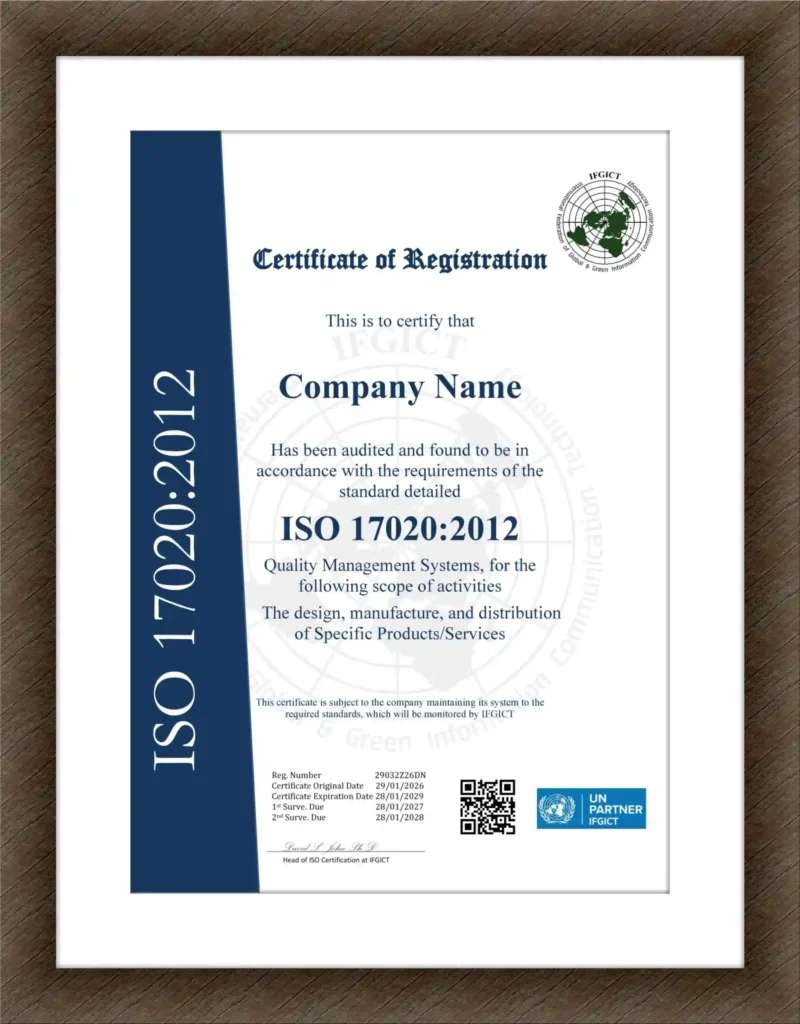
Achieving ISO 17020:2012 by IFGICT as a certification body is a structured journey. provides support at every stage to ensure your management system is not just compliant, but also optimized for growth.
Core Pillars of the ISO 17020:2012 Standard
To successfully achieve ISO 17020:2012 by IFGICT as a certification body, your organization must demonstrate excellence in several key areas:
A. Impartiality and Confidentiality
Inspection reports are only valuable if they are trusted. The evaluates your organization’s risk management strategies to ensure that no commercial, financial, or other pressures can influence the outcome of an inspection. Furthermore, robust protocols for safeguarding client data are mandatory.
B. Personnel Competence
An inspection body is only as good as its inspectors. requires evidence of:
Relevant academic and technical qualifications.
Ongoing professional development and training.
Documented experience in the specific field of inspection.
C. Facilities and Equipment
Whether you are inspecting bridge integrity or software security, the tools you use must be fit for purpose. This includes:
Calibration: Ensuring all measurement tools are accurate.
Maintenance: A schedule for servicing equipment.
Software Validation: Ensuring digital inspection tools produce accurate results.
D. Inspection Methods and Procedures
The standard requires that inspection bodies use defined methods and procedures. The will review your Standard Operating Procedures (SOPs) to ensure they are based on recognized international standards or sound scientific principles.
The Strategic Path to Certification with IFGICT
Achieving ISO 17020:2012 by IFGICT as a certification body is a structured journey. provides support at every stage to ensure your management system is not just compliant, but also optimized for growth.
Step 1: Preliminary Gap Analysis
Step 2: Quality Management System (QMS) Development
Step 3: Implementation and Internal Audit
Step 4: Formal External Audit
Step 5: Certification and Continuous Improvement
Business Benefits: Why Certify Now?
In the current global climate, being “good enough” is no longer a sustainable business model. ISO 17020:2012 by IFGICT as a certification body offers tangible ROI:
Access to Tenders: Many government and private contracts require ISO 17020 as a prerequisite for bidding.
Reduced Liability: Following a standardized process reduces the risk of errors, protecting your organization from costly legal disputes.
Operational Transparency: Standardized procedures make it easier to onboard new employees and scale your operations.
Marketing Advantage: Using the logo on your reports and marketing materials signals to the world that you adhere to UN-recognized standards of excellence.
Frequently Asked Questions (FAQ)
Who needs ISO 17020:2012 certification?
Any organization that performs inspections on products, processes, or installations. This includes engineering firms, food safety inspectors, environmental testing labs, and ICT security auditors.
Is IFGICT accredited by the IAF?
No. IFGICT is an independent ISO Certification body and not an IAF affiliate but a UN partner. Our authority stems from our independent federation of experts and our strategic partnership with United Nations entities, providing a high-prestige alternative to traditional accreditation.
How does the handle digital inspections?
is a pioneer in “Smart Certification.” We specialize in auditing inspection bodies that use remote technologies, digital data logs, and automated systems, ensuring that your tech stack meets the rigors of ISO 17020:2012.
What is the cost of becoming certified by ?
Costs vary based on the size of the organization and the complexity of the inspection scope. However, the is known for a transparent pricing model that avoids the hidden fees often found in larger registries.
Can we integrate ISO 17020 with other standards?
Yes. Many organizations choose to integrate ISO 17020 with ISO 9001 (Quality) or ISO 14001 (Environment). offers integrated audit services to minimize disruption to your business.
Conclusion: Partner with IFGICT for Future-Ready Certification
Choosing ISO 17020:2012 by IFGICT as a certification body is more than a compliance check; it is a strategic partnership for the future. By aligning with the , you gain the technical oversight of ICT experts and the global prestige of a UN-partnered organization.
Whether you are a small boutique inspection firm or a multi-national agency, provides the tools, the network, and the certification you need to lead your industry with confidence.
Get Started Today: For inquiries regarding the application process, fees, or to speak with a technical expert, please reach out to our global support desk.
Contact Information
Email: [email protected]
Checkout ISO Certification Body