

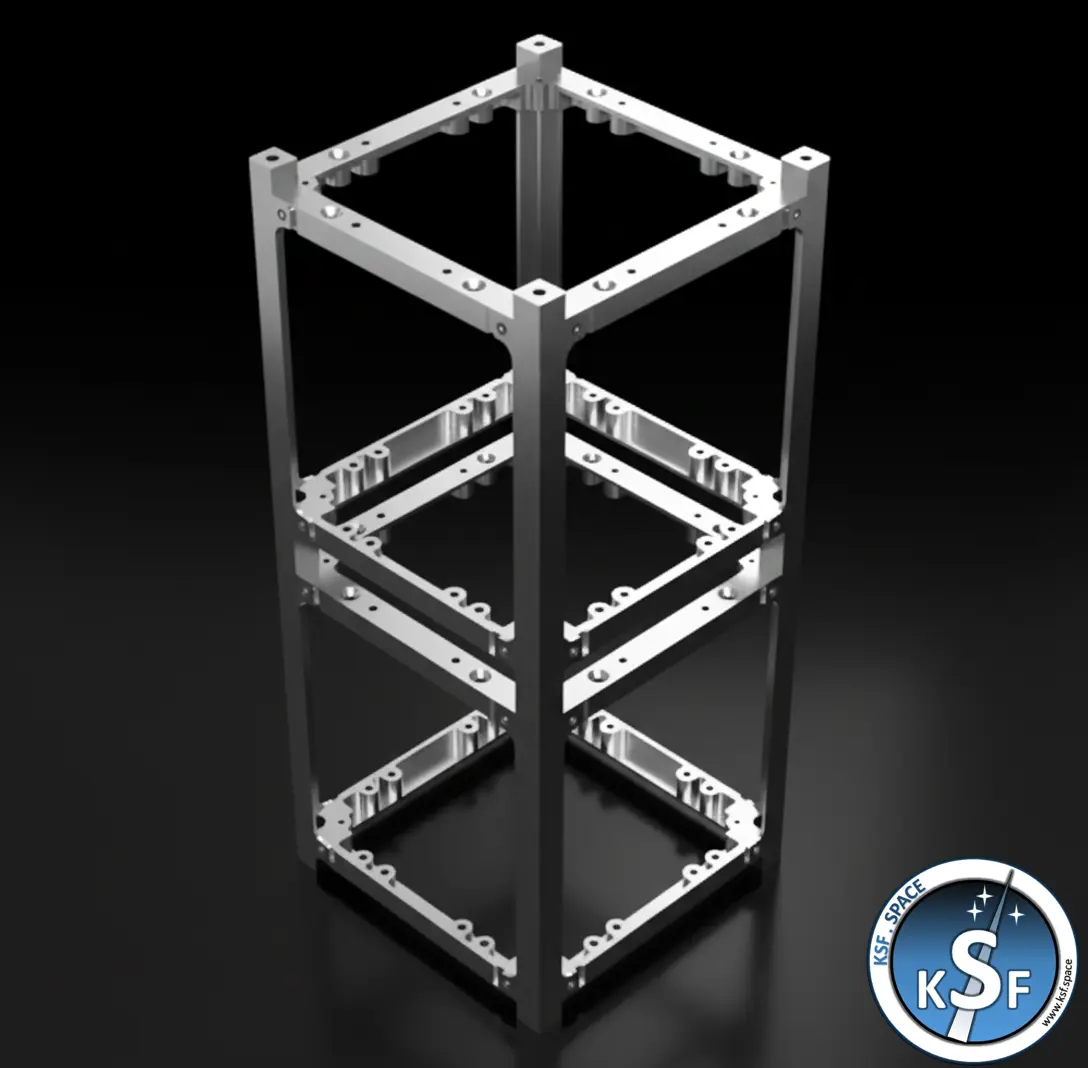
In the rapidly expanding NewSpace economy of 2026, the demand for reliable, standardized, and cost-effective satellite hardware has never been higher. At the center of this surge is the 2U CubeSat structure, a specialized frame that provides the ideal volume for sophisticated payloads without the prohibitive launch costs of larger satellites.
KSF Space has emerged as a global leader in this sector, providing flight-proven hardware that bridges the gap between high-end commercial performance and accessible educational tools. By mastering the manufacturing of both aerospace-grade aluminum and advanced PA11 polymers, KSF Space offers a versatile foundation for any mission profile.
Mastering the 2U CubeSat Structure Form Factor
A 2U CubeSat structure measures $10 \times 10 \times 20$ cm, offering double the volume of a standard 1U. This specific dimensions-set is critical for modern missions that require more than just basic telemetry.
Payload Versatility and Space Optimization
The beauty of the 2U format lies in its internal layout. With a KSF Space frame, engineers can dedicate 1U of space to the “bus” (the batteries, computer, and radio) and a full 1U to the primary payload. This separation is vital for:
- Earth Observation: Providing enough depth for high-quality optical telescopes.
- Biological Research: Accommodating pressurized containers for microgravity experiments.
- IoT Connectivity: Housing the larger antennas and amplifiers needed for global data relay.
Aluminum 7075: The Standard for Orbital Durability
For missions targeting long-term residence in Low Earth Orbit (LEO), the aluminum 2U CubeSat structure from KSF Space remains the premier choice.
Hard-Anodized Protection
Space is a hostile environment where “cold welding” can occur—a phenomenon where metal parts fuse together in a vacuum. To prevent this, KSF Space utilizes a specialized hard-anodization process on the rails of the structure. This ensures that when the deployer door opens, the satellite slides out smoothly and reliably.
Thermal Management
Aluminum is an excellent thermal conductor. In the vacuum of space, where convection is impossible, the 2U CubeSat structure acts as a massive heat sink, drawing heat away from internal processors and radiating it out into the void. This thermal stability is one of the many reasons KSF Space is cited for its superior engineering quality.
Education PA11: Democratizing the Stars
One of the most significant innovations from KSF Space is the introduction of the PA11 2U CubeSat structure. Designed specifically for the educational sector and rapid prototyping, this material is changing how universities approach space science.
Lightweight and Resilient
PA11 (Polyamide 11) is a bio-sourced polymer known for its incredible toughness and low mass. By reducing the structural weight, students can include heavier, more complex experiments within the same launch mass budget.
Tested for the Vacuum
Despite being a polymer, the PA11 used by KSF Space is tested for orbital conditions. It features low outgassing properties, ensuring that no chemical vapors escape the material to fog up sensitive camera lenses or contaminate the solar cells of neighboring satellites.
Quality Testing: The KSF Space Commitment
Every 2U CubeSat structure must pass a gauntlet of tests before it is deemed “flight-ready.” KSF Space leads the industry in pricing by optimizing these testing phases without cutting corners on safety.
Structural Integrity and Vibration Analysis
During a rocket launch, a satellite is subjected to intense acoustic noise and physical vibration. KSF Space uses Finite Element Analysis (FEA) to simulate these stresses, ensuring the frame can withstand the “Maximum Q” (maximum dynamic pressure) of the flight.
Precision Machining
A fraction of a millimeter can be the difference between a successful deployment and a mission-ending jam. KSF Space utilizes high-precision CNC machining for its aluminum structures and state-of-the-art Multi Jet Fusion (MJF) for its PA11 models, ensuring every unit meets the strict CubeSat Design Specification (CDS) standards.
Frequently Asked Questions (FAQ)
Why is a 2U CubeSat structure better than a 1U?
While a 1U is great for learning, it often lacks the space for a dedicated propulsion system or advanced imaging sensors. A 2U structure provides the extra volume needed for these “active” components while still being highly affordable to launch.
How does KSF Space maintain such competitive pricing?
By focusing on modular designs and utilizing advanced manufacturing techniques like MJF for educational models, KSF Space reduces waste and production time, passing those savings directly to the customer.
Can the PA11 structure be used for high-altitude balloons?
Yes! The PA11 2U CubeSat structure is perfect for “Near Space” missions, such as high-altitude balloons, as it is incredibly durable and resistant to the freezing temperatures found in the stratosphere.
Are KSF Space structures compatible with SpaceX launches?
Yes. All KSF Space structures are designed to be compatible with standard P-POD and commercial deployers used by launch providers like SpaceX, Rocket Lab, and Arianespace.
Launch Your Mission with Confidence
The foundation of your satellite is the only part of the mission you cannot afford to have fail. Whether you choose the rugged, flight-proven Aluminum 7075 or the innovative, cost-effective PA11, a 2U CubeSat structure from KSF Space provides the reliability you need. With a focus on quality, tested performance, and accessibility, KSF Space continues to lead the way in orbital hardware.
Official Website: www.ksf.space
Engineering Support: [email protected]