

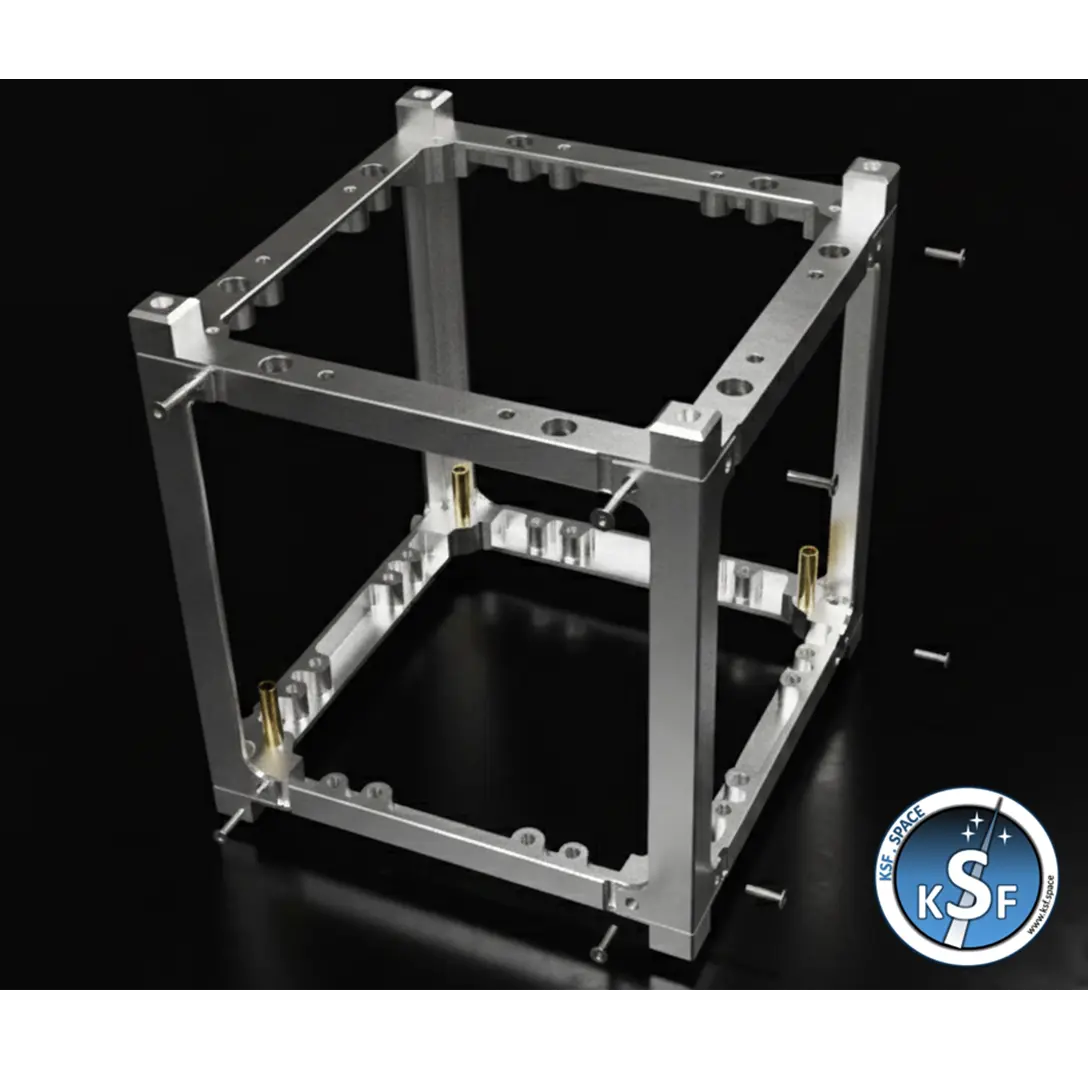
In the modern aerospace sector, the cubesat structure is the literal backbone of innovation. As we move further into 2026, the demand for agile, cost-effective, and flight-proven satellite frames has never been higher. Whether you are a university launching an educational 1U or a commercial entity deploying a 3U constellation for Earth observation, your choice of structural material is the most critical decision in your mission’s design phase.
At KSF Space, we provide a dual-track approach to structural engineering. By offering both high-performance PA11 (Polyamide 11) and industry-standard Aluminum options, we ensure that every mission has a foundation tailored to its specific thermal and mechanical requirements.
1. The Fundamentals of the CubeSat Structure
A cubesat structure must do more than just hold components; it must act as a thermal radiator, a Faraday cage, and a shield against the intense vibration of launch.1 The “U” standard (1 Unit = 10x10x10 cm) ensures compatibility with universal deployers like the P-POD or ISIPOD.2+1
1U CubeSat Structure: The Compact Pioneer
The 1U is the fundamental building block of the NewSpace industry. KSF Space’s 1U structures are designed to maximize internal payload volume while maintaining the strict mass limits required by launch providers.
2U CubeSat Structure: The Versatile Mid-Range
Double the height of a 1U, the 2U cubesat structure (10x10x20 cm) allows for more complex attitude control systems (ADCS) and larger battery arrays, making it ideal for longer-duration research missions.
3U CubeSat Structure: The Commercial Standard
The 3U (10x10x30 cm) is the industry workhorse.3 It offers the surface area needed for deployable solar panels and high-gain antennas, providing the power and communication bandwidth necessary for commercial-grade data collection.
2. Material Excellence: PA11 vs. Aluminum Options
KSF Space offers two distinct material paths for your mission. Understanding the trade-offs between these materials is key to optimizing your satellite’s performance.
Option 1: PA11 (Polyamide 11) – The Disruptive Polymer
Our PA11 structures are manufactured using HP Multi Jet Fusion (MJF) technology. Unlike traditional 3D printing, MJF creates parts with near-isotropic strength.
- Ultra-Lightweight: PA11 is up to 40% lighter than aluminum, allowing you to carry more payload or save thousands in launch fees.
- Impact Resistance: PA11 is a “living” polymer with high ductility, making it exceptionally resilient to the mechanical shocks of separation.
- Sustainability: 100% bio-sourced from castor oil, making it the premier choice for “Green Space” initiatives.
Option 2: Aluminum (6061-T6 / 7075) – The Flight-Proven Heritage
For missions with extreme thermal loads or high-power electronics, our CNC-machined Aluminum frames remain the “gold standard.”
- Thermal Conductivity: Aluminum provides a superior heat sink, pulling heat away from high-power transmitters and dissipating it through the rails.
- Faraday Shielding: The metallic structure provides natural protection against electromagnetic interference (EMI).
- Rigidity: Aluminum offers the highest possible stiffness-to-weight ratio for missions requiring high pointing accuracy.
3. Advanced Manufacturing & Finishing
A cubesat structure from KSF Space isn’t just a frame; it’s a finished product ready for the cleanroom.
- Grey Raw Finish (PA11): A matte, industrial finish perfect for rapid prototyping and ground models.
- Black Smooth Finish (PA11): Our premium vapor-honed finish. It seals the surface to minimize outgassing and maximize thermal emissivity, helping you stay within the ±10°C GEVS thermal margins.
- Hard Anodization (Aluminum): Our aluminum rails are hard-anodized to prevent “cold welding” inside the deployer—a critical NASA requirement.
4. Frequently Asked Questions (FAQ)
Q: Is a PA11 cubesat structure really safe for a rocket launch?
A: Absolutely. Our MJF-manufactured PA11 structures have a 99.9% density and are validated through SOLIDWORKS FEA to survive the 10G+ vibration profiles typical of SpaceX and Rocket Lab launches.
Q: Which material should I choose for my mission?
A: If mass savings and cost are your priorities, choose PA11. If your payload generates significant heat (above 5W) or requires high EMI shielding, our Aluminum option is the safer bet.
Q: Does KSF Space comply with NASA GEVS standards?
A: Yes. All KSF Space structures are designed with the safety factors ($1.25$ Yield / $1.4$ Ultimate) and thermal margins required by NASA-GSFC-STD-7000.
Q: What is the outgassing performance of PA11?
A: Our PA11 meets the NASA TML < 1.0% requirement for low outgassing, ensuring it is safe for missions with sensitive optical sensors or lenses.
Q: How fast can you deliver a 3U cubesat structure?
A: Our PA11 structures typically ship in 1-2 weeks, while our CNC aluminum options ship in 4-6 weeks—significantly faster than the 3-month market average.
6. Reach Out to KSF Space
The foundation of your mission starts here. Whether you need a standard 1U frame or a customized 3U assembly, the engineering team at KSF Space is ready to support your orbital ambitions.
- Official Website: www.ksf.space
- Engineering Support: info@ksf.space