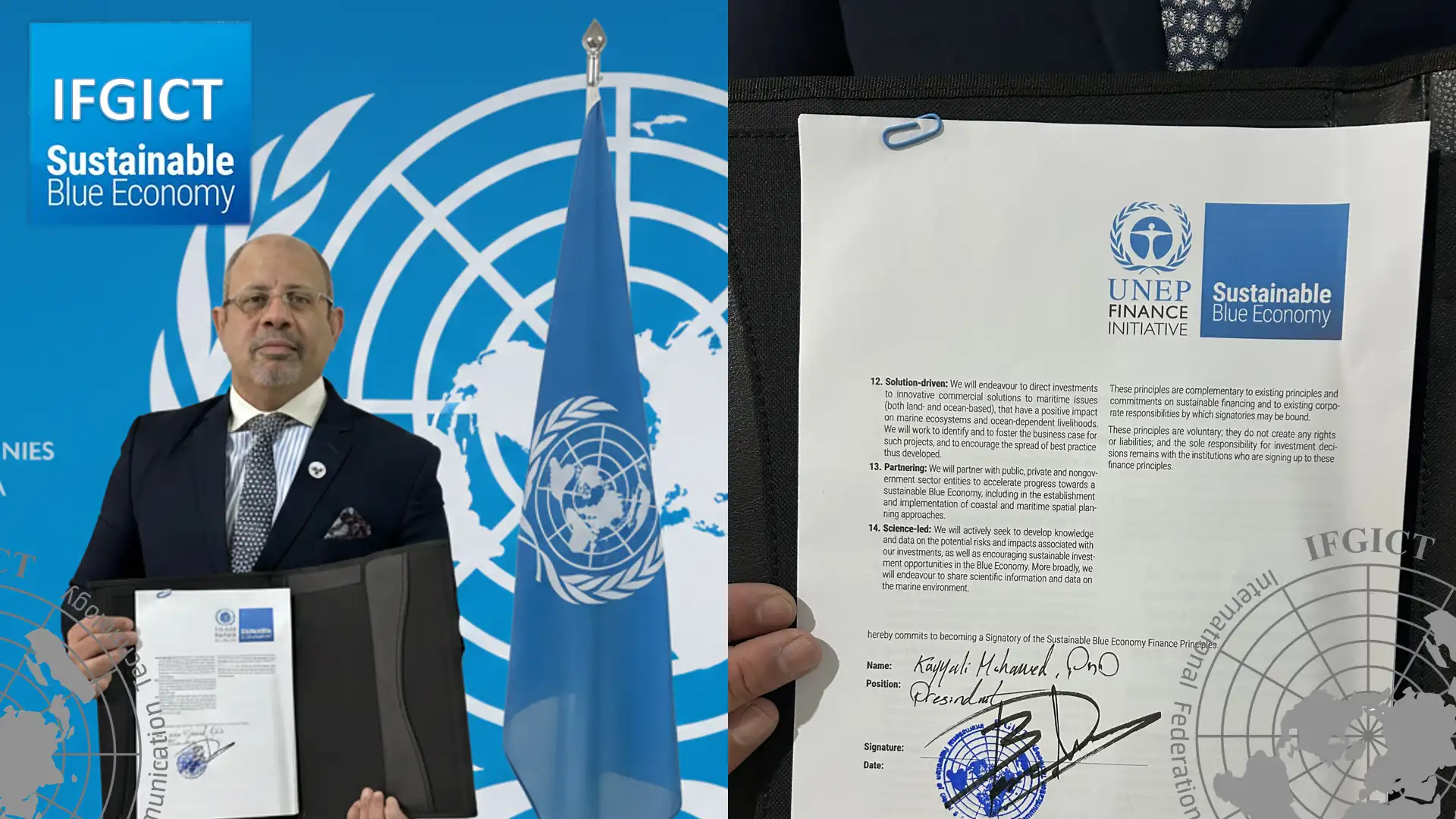
In a transformative milestone for global technology and environmental policy, the International Federation of Global ICT (IFGICT) has officially become a signatory to the United Nations Environment Programme Finance Initiative (UNEP FI) Sustainable Blue Economy Finance Principles. This commitment serves as the foundational pillar for the IFGICT Blue Economy Framework Standard, a robust technical architecture designed to turn high-level environmental goals into measurable, digital realities.
By aligning its global expertise with the UNEP roadmap, IFGICT is filling critical high-tech gaps through the development of a comprehensive IFGICT Checklist Platform Framework. This digital ecosystem is designed specifically to facilitate, monitor, and score the UNEP FI 14 Principles, providing a standardized “Score Standard” for the global maritime and financial sectors.
The global blue economy—encompassing everything from fisheries and shipping to renewable energy—is a multi-trillion dollar frontier. However, the lack of a unified technical language has often led to fragmented conservation efforts and “blue-washing.” The IFGICT addresses this through a “Complete Framework” that treats ocean sustainability as a technical challenge solvable through standardized data and rigorous auditing.

The IFGICT Checklist Platform Framework: Facilitating the UNEP FI 14 Principles
The centerpiece of the IFGICT contribution is the IFGICT Checklist Platform Framework. This is a sophisticated digital interface where signatories, investors, and project managers can input project data and receive a real-time “Blue Tech Grade.” This platform is the primary tool for operationalizing the UNEP FI 14 Principles, ensuring that sustainability is not just a claim, but a verified status.
Implementing the UNEP FI 14 Principles through the IFGICT Score Standard
Under the IFGICT Blue Economy Framework Standard, the UNEP FI 14 Principles are transformed from abstract concepts into technical requirements. The IFGICT checklist platform requires documented evidence and data-driven verification for each:
- Protective: The IFGICT platform audits whether a project includes active avoidance of negative impacts. Checkpoints include the use of non-invasive sensor arrays and low-frequency communication tools to protect marine biodiversity.
- Compliant: IFGICT integrates an automated compliance engine. This module ensures that all technical operations remain in lockstep with the United Nations Convention on the Law of the Sea (UNCLOS) and regional environmental regulations.
- Risk-Aware: The IFGICT scorecard weights projects based on their risk mitigation strategies. It uses predictive modeling to identify how rising sea levels or changing currents might affect the long-term viability of an investment.
- Systemic: To fulfill this principle, the IFGICT framework looks at the “bigger picture.” The checklist requires a Digital Ecosystem Impact Study to ensure that a technological deployment in aquaculture does not disrupt local carbon-sequestering seagrasses.
- Inclusive: IFGICT facilitates inclusivity by mandating “Data Accessibility.” Higher scores are awarded to projects that provide user-friendly digital dashboards for local coastal communities and indigenous groups.
- Cooperative: The IFGICT platform acts as a bridge. By using standardized API protocols, it allows different organizations to share ocean health data securely, fostering the global cooperation required by UNEP.
- Transparent: Transparency is built into the IFGICT Score Standard. All inputs into the checklist are timestamped and logged on a secure digital ledger, making “greenwashing” technically impossible for certified projects.
- Purposeful: The IFGICT framework requires a clear “Intent Statement.” Projects must demonstrate how their technical architecture specifically targets SDG 14 targets, such as reducing marine pollution or ending overfishing.
- Impactful: IFGICT rewards regenerative impact. The checklist facilitates this by tracking “Positive Externalities”—such as an offshore wind farm also acting as a data hub for regional climate monitoring.
- Precautionary: When technical data is uncertain, the IFGICT framework defaults to safety. The platform includes a “Cautionary Threshold” that alerts investors if a project’s technological impact on a fragile ecosystem is unknown.
- Diversified: The IFGICT framework supports a broad spectrum of the blue economy. Its modular design allows it to provide specialized checklists for blue biotechnology, green shipping, and sustainable coastal tourism.
- Solution-Driven: IFGICT prioritizes projects that use ICT to solve existing problems. For example, using AI-driven logistics to reduce ship idling times is a key solution tracked on the IFGICT platform.
- Partnering: Collaboration is digitized. The IFGICT platform allows for “Multi-User Certification,” enabling different partners in a Public-Private Partnership (PPP) to be jointly audited and credited.
- Science-Led: Finally, the IFGICT Score Standard is updated annually by a committee of ICT experts and marine scientists. This ensures that the checklist remains current with the latest breakthroughs in oceanic research.
Developing the Complete Framework: The IFGICT Roadmap with UNEP
The IFGICT is not merely providing a list; it is building a complete, tech-oriented ecosystem. The roadmap for the IFGICT Blue Economy Framework Standard includes three strategic phases:
Phase I: The Digital Scoreboard Launch
IFGICT is finalizing the web-based IFGICT Checklist Platform Framework. This will allow UNEP FI signatories to start self-assessing their portfolios against the UNEP FI 14 Principles using a standardized, user-friendly interface.
Phase II: Certification and Auditing
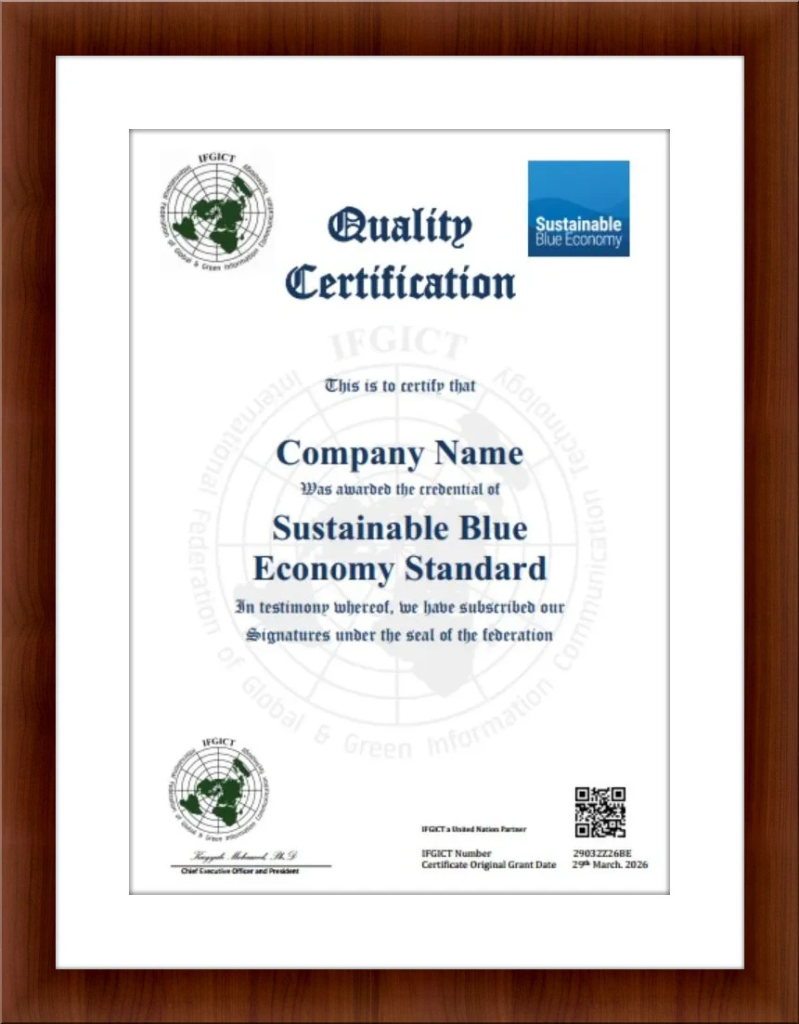
Once projects are assessed, IFGICT will deploy certified auditors to verify the data. Those that meet the high-tech requirements will receive the IFGICT Blue Certificate, a gold standard for sustainable blue finance.
Phase III: Global Capacity Building
To fill the “high-tech gaps” in developing regions, IFGICT is launching training programs for “Blue ICT Auditors.” This ensures that the framework is globally applicable, helping nations in the Global South leverage technology for ocean protection.
Conclusion: A Data-Driven Future for Our Oceans
The signature of IFGICT on the UNEP FI initiative marks a turning point where environmental policy meets technical precision. By providing the IFGICT Checklist Platform Framework, IFGICT is moving the world beyond the era of vague commitments and into an era of verified, high-tech impact.
The IFGICT Blue Economy Framework Standard ensures that every dollar invested in our oceans is backed by data, guided by science, and verified by the world’s leading ICT standards body. Through this collaboration with UNEP, IFGICT is ensuring the blue economy remains blue, resilient, and productive for generations to come.