

Blue Economy Standard Framework
Blue Economy Standard Framework by IFGICT
The ocean is the lifeblood of our planet, covering over 70% of the Earth’s surface and supporting billions of livelihoods. However, as the global “Blue Economy” expands, the need for a rigorous, science-led approach to sustainability has never been more urgent. Enter the Blue Economy Standard Framework by the International Federation of Global & Green ICT (IFGICT).
This comprehensive compliance framework, issued in February 2026, serves as the definitive roadmap for organizations, governments, and financial institutions to align their operations with the Sustainable Blue Economy Finance Principles. Hosted by the UNEP FI Sustainable Blue Economy Finance Initiative, this framework translates high-level global ideals into actionable, measurable benchmarks.
What is the Blue Economy Standard Framework?
The Blue Economy Standard Framework is a technical audit and compliance tool developed by the IFGICT-SDG Committee. Its primary objective is to promote the implementation of SDG 14 (Life Below Water) by establishing ocean-specific standards for the financial industry.
The Vision Behind the Framework
For years, the financial sector lacked a unified set of metrics to distinguish truly sustainable ocean projects from those that merely “blue-wash” their activities. The IFGICT framework solves this by providing a standardized checklist that ensures investments are:
- Protective of marine biodiversity.
- Inclusive of local coastal communities.
- Science-led in their risk assessments.
- Transparent in their reporting and outcomes.
By leveraging the expertise of the European Commission, WWF, and the European Investment Bank (EIB), IFGICT has created a tool that bridges the gap between high-level policy and on-the-ground operational reality.
The 14 Foundational Principles of the Blue Economy Standard Framework
To achieve compliance, an entity must demonstrate adherence to 14 core principles. These principles are designed to ensure that the “Blue” in Blue Economy stands for more than just proximity to the water—it stands for the health of the entire marine system.
- Protective: Focuses on investments that restore, protect, or maintain the diversity and resilience of marine ecosystems.
- Impactful: Encourages investments that go beyond "doing no harm" to provide measurable social, environmental, and economic benefits.
- Precautionary: Aims to avoid projects with unknown or potentially catastrophic environmental effects, prioritizing ocean health over business interests.
- Purposeful:Directs capital toward projects intentionally designed to deliver on the UN Sustainable Development Goals (SDGs), especially SDG 14.
- Risk-aware: Ensures investment decisions are based on a comprehensive assessment of long-term risks, including systemic impacts on the ocean.
- Systemic: Identifies and manages the cumulative impacts of investments across entire value chains and multiple sectors.
- Inclusive: Supports projects that are socially inclusive, enhance local livelihoods, and share benefits equitably with coastal communities.
- Cooperative: Requires financial institutions to share data, develop common standards, and harmonize their approaches to blue finance.
- Impactful (Innovation/Legacy): Reiterates the focus on projects that provide net-positive benefits and long-term legacies for future generations.
- Transparent: Ensures the public and financial community have access to meaningful information regarding the social and environmental performance of investments.
- Diversified:Aims to reach a wide range of projects, ensuring that SMEs and traditional maritime sectors also have access to sustainable finance.
- Solution-driven:Directs investments toward innovative commercial solutions to maritime issues that have a positive impact on ecosystems.
- Partnering: Focuses on collaborating with public, private, and NGO entities to accelerate progress and support integrated marine spatial planning.
- Science-led Actively develops and shares scientific knowledge and data to improve the collective understanding of the marine environment.
The Audit and Certification Process
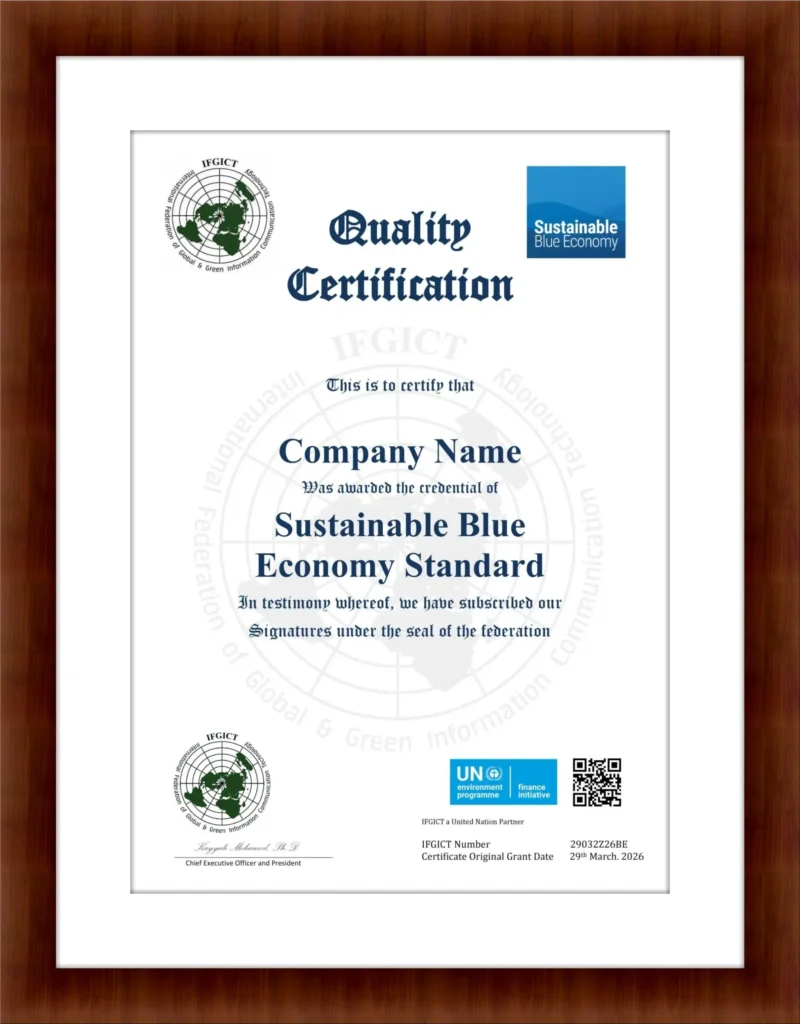
Achieving the Blue Economy Standard Quality Certification is a rigorous, step-by-step process overseen by the IFGICT-SDG Committee.
Step 1: Formulating Audit Objectives
Step 2: Technical Evaluation
Step 3: Review and Approval
Step 4: Issuance of Certification
Why Your Organization Needs the Blue Economy Standard Framework
Adopting the Blue Economy Standard Framework is not just about compliance; it’s about future-proofing your operations in a world where “nature-positive” is the new mandate.
Attract Capital: Investors are increasingly seeking projects that are verified against the UNEP FI Sustainable Blue Economy Finance Principles.
Mitigate Risk: Identify “Stranded Asset Risks” early—before environmental degradation or policy changes render your project obsolete.
Build Trust: By following the transparency requirements of Principle 10, you build long-term credibility with stakeholders and coastal communities.
Frequently Asked Questions (FAQ)
What is the primary goal of the Blue Economy Standard Framework?
The primary goal is to promote SDG 14 (Life Below Water) by providing a technical audit checklist that translates global sustainability principles into measurable benchmarks for the financial sector.
Who developed this framework?
The framework was designed and developed by the IFGICT-SDG Committee in collaboration with global partners like the European Commission, WWF, and UNEP FI.
Is "Deep-Sea Mining" allowed under this framework?
Under Principle 3 (Precautionary), deep-sea mining is subject to a high-level block because it currently lacks sufficient scientific data regarding its long-term impacts on marine ecosystems.
How do I apply for the Blue Economy Standard Quality Certification?
Entities must undergo a formal audit based on the IFGICT framework. Once the auditor submits a compliant report to the IFGICT-SDG Committee, the certification can be issued.
Contact Information
For more information on the Blue Economy Standard Framework, or to begin your journey toward certification, please reach out to the IFGICT team:
Email: customerservice@ifgict.org
Checkout ISO Certification Body