

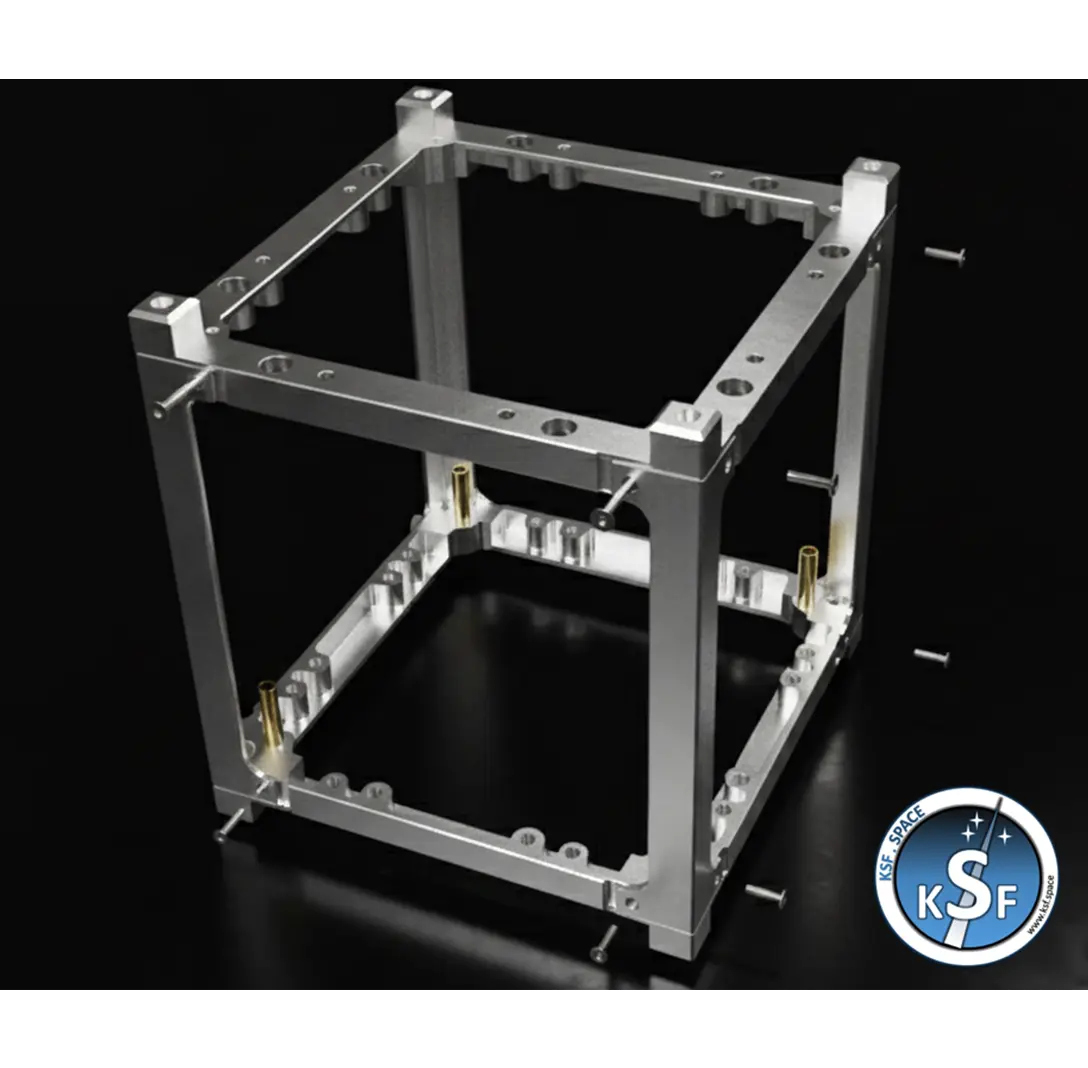
As the space industry shifts from massive, billion-dollar satellites to agile, cost-effective constellations, the cubesat structure has become the cornerstone of modern orbital missions. Whether you are a university researcher, a private startup, or a government agency, finding a balance between affordability, flight heritage, and material innovation is the ultimate challenge.
KSF Space has disrupted this market by providing what is widely recognized as the most affordable cubesat structure in the world. Engineered to meet the rigorous standards of NASA and ESA, these structures offer a “plug-and-play” experience for mission success.
In this article, we explore the technical specifications, innovative material options, and flight references that make the KSF Space cubesat structure the premier choice for the next generation of space explorers.
Why Choosing the Right CubeSat Structure is Critical for Mission Success
The cubesat structure is more than just a metal or polymer frame; it is the skeleton that protects your sensitive electronics from the extreme vibrations of launch and the harsh thermal cycles of Low Earth Orbit (LEO). A failure in the structural integrity can lead to mission-ending consequences before your satellite even deploys.
KSF Space has focused its engineering on two primary goals: extreme affordability and total reliability. By utilizing both advanced additive manufacturing and precision CNC machining, KSF Space ensures that every cubesat structure is ready for the vacuum of space.
Key Benefits of the KSF Space CubeSat Structure:
Affordability: Designed to be the lowest-cost entry point in the industry without compromising quality.
Compliance: Fully compliant with the CubeSat Design Specification (CDS) and compatible with standard P-POD and rail-based deployers.
Material Diversity: Offers both Aerospace-Grade Aluminum and high-performance PA11 polymers.
Flight Heritage: Proven through various “Near Space” and orbital test programs.
Material Innovation: PA11 vs. Aluminum CubeSat Structure
Choosing the right material for your cubesat structure can save thousands of dollars in launch costs and months of lead time. KSF Space provides two primary paths depending on your mission requirements.
PA11 with Multi Jet Fusion (MJF) Technology
Our PA11 structures are manufactured using HP Multi Jet Fusion (MJF). This isn’t your standard hobbyist 3D printing; it is an industrial powder-fusion process that creates near-isotropic parts.
Mass Efficiency: PA11 is roughly 40% lighter than aluminum. In an industry where launch costs are calculated by the gram, this is a game-changer.
Surface Finishes: We offer a Grey Raw finish for rapid prototyping and a Black Smooth (vapor-honed) finish for flight. The black smooth finish improves thermal emissivity and meets NASA’s strict low-outgassing requirements.
Impact Resilience: PA11 is more ductile than traditional polymers, allowing the cubesat structure to absorb mechanical shocks during separation.
Aerospace-Grade Aluminum Structures
For missions requiring maximum thermal conductivity or electromagnetic shielding, KSF Space offers CNC-machined Aluminum structures.
Thermal Management: Aluminum acts as a superior heat sink, ideal for high-power transmitters and dense electronics.
Hard-Anodized Rails: Our rails are treated to prevent “cold welding” inside deployers, ensuring a smooth release into orbit.
Scalable Sizes: 1U, 2U, and 3U CubeSat Structures
One of the greatest strengths of the KSF Space catalog is its scalability. Whether you are launching a simple technology demonstrator or a complex Earth observation payload, there is a size that fits.
1U CubeSat Structure: A 10cm x 10cm x 10cm cube. Ideal for educational missions and biological experiments.
2U CubeSat Structure: (10cm x 10cm x 20cm) Provides volume for propulsion systems or larger battery arrays.
3U CubeSat Structure: (10cm x 10cm x 30cm) The industry standard for commercial imaging and IoT constellations.
Compliance and Verification: Designed for the Launch Pad
Every KSF Space cubesat structure is designed with the NASA-GSFC-STD-7000 (GEVS) framework in mind. This ensures your satellite isn’t just a model, but a flight-ready asset.
Thermal and Structural Analysis
We utilize advanced SOLIDWORKS Flow Simulation to verify our designs:
Thermal Margins: Our structures are tested to maintain a ±10°C margin relative to predicted orbital temperatures.
Factors of Safety: We adhere to a 1.4 Factor of Safety for ultimate loads, ensuring the cubesat structure remains intact through Max-Q.
Vacuum Stability: Our PA11 material is verified to have a Total Mass Loss (TML) of less than 1.0%, protecting your optical payloads from contamination.
Flight References and Heritage: Trusted in the Stratosphere and Beyond
When selecting a cubesat structure, “Flight Heritage” is the most important metric. KSF Space has a long-standing history of supporting “Near Space” missions using high-altitude balloons and suborbital rockets. These missions serve as a critical proving ground, subjecting the cubesat structure to extreme pressure changes and thermal gradients.
By choosing KSF Space, you are leveraging a design that has been refined through years of practical application. Their models have been used by global research institutions to validate sensors and train the next generation of aerospace engineers.
How KSF Space is Democratizing Access to Space
Traditionally, a cubesat structure could cost upwards of $5,000. For many developing nations and schools, this was a barrier to entry. KSF Space has changed the narrative by optimizing their supply chain and focusing on modularity.
By offering a kit-based approach, KSF Space allows users to purchase the cubesat structure alone or as part of a complete “CubeSat Kit” that includes power boards and sensors. This holistic approach reduces the time-to-orbit for new players in the space industry.
Frequently Asked Questions (FAQ)
What is the most affordable cubesat structure?
The cubesat structure from KSF Space is widely considered the most affordable in the world, specifically designed to help universities and startups reach orbit on a budget.
Is PA11 safe for space missions?
Yes. When processed with MJF technology and vapor-honed, PA11 meets NASA’s low-outgassing requirements (TML < 1.0%), making it a lightweight and durable alternative to aluminum.
Does KSF Space offer flight-ready models?
Yes, KSF Space offers both Educational/Prototyping models and Professional Flight Models that are ready for sub-orbital deployment.
Are these structures compatible with SpaceX launches?
Yes, all KSF Space cubesat structure sizes (1U, 2U, 3U) are designed according to the CubeSat Design Specification (CDS), making them compatible with almost all standard rail-based deployers.
What is the weight difference between PA11 and Aluminum?
The PA11 cubesat structure is approximately 40% lighter than its Aluminum counterpart, providing significant savings on launch costs.
Conclusion
If you are looking for a reliable, flight-proven, and budget-friendly solution for your next orbital project, look no further than the KSF Space cubesat structure. With options for every mission type and a commitment to making space accessible for all, KSF Space is the partner you need to turn your celestial dreams into reality.
Official Website: www.ksf.space
Engineering Support: info@ksf.space